This article is for sellers who handle celebrity photo books, DVDs, and merchandise, or lingerie and adult goods, on Amazon.co.jp, and for anyone who has received a warning over these products. It explains the rules that apply, what to check for each type of product, the steps to take before listing, how to sort out which policy a notification concerns, and how to think about filing an appeal.
The big picture: policies that apply to celebrity-related and adult products
Celebrity-related and adult-related products are covered by several Help pages at once, and their policies overlap.
| Help page | What it mainly covers |
|---|---|
| Restricted Products | Enforcement actions for violations (the examples given are not exhaustive) |
| Adult Products | Examples of prohibited listings, ethics review numbers, performer age at filming |
| Adult Products Policy and Guidelines | Scope of what can be sold, the adult flag, restrictions on creating catalog listings |
| Offensive Products | Products that sexualize children, among other examples |
| Other Products | Doujinshi (fan-made publications) without a JAN or ISBN code cannot be listed |
| Amazon Intellectual Property Policy | Unauthorized use of images or text |
You may have heard that "products related to female celebrities can't be listed," but Amazon's Help content has no rule that distinguishes by gender. The restrictions run along four axes: sexual depiction, age, rights, and whether a catalog listing can be created. Gravure and idol-related products tend to raise the most red flags because they often fall under several of these axes at once — images with exposure, the performer's age at filming, and catalog restrictions.
This article reflects information as of September 2026. Policies and on-screen labels can change, so please also check the latest Help content.
What can happen if you violate these policies
Selling a prohibited product can lead to measures such as having the listing suspended or ended, FBA inventory being disposed of without compensation, and your selling privileges being restricted, suspended, or revoked (the exact outcome depends on the type of violation and your history). The policies for Adult Products, Restricted Products, Intellectual Property, Product Detail Pages, and Condition all count toward the Account Health Rating, and if violations of the same policy reach the limit within 180 days, your account can be suspended immediately. For higher-severity violations, that limit may be as low as two. We cover the mechanics in checking your Account Health score.
Rules for adult products: what you can sell and how to list it
The default is a ban — merchandise items are allowed only in the drugstore store's designated browse nodes
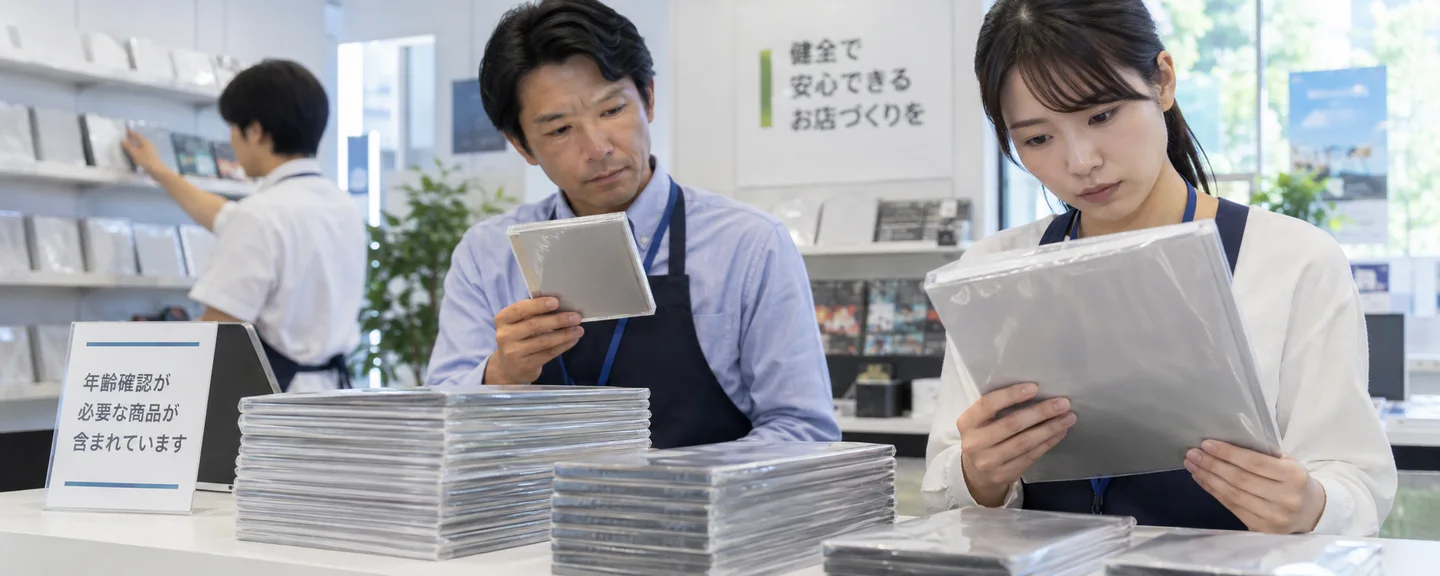
Amazon.co.jp generally prohibits selling adult products. The exception is the drugstore store: cosplay (costumes), sexy lingerie, and adult goods can be sold only if they belong to the browse nodes (product classification categories) that Amazon.co.jp has designated for them, and they are sold only to buyers who have completed age verification inside the Adult store. Registering these items under an ordinary clothing category instead can amount to listing an adult product outside its designated browse node, which is one of the examples of a prohibited listing. Adult media products such as DVDs and books, meanwhile, may be listed and registered only if they meet the requirements described below.
The drugstore listing guidelines (PDF) linked from the Adult Products Policy and Guidelines page date from 2018, so check the current screens for details such as browse nodes. For help reviewing your classification, see how to fix a product's category.
Listing without setting the "adult flag" is prohibited
Products with sexual content, or that could reasonably be interpreted that way, may not be listed without setting the adult flag. For media products such as books and DVDs, you set the flag according to the adult-content designation given by the manufacturer or publisher. Amazon states that it uses its own discretion to decide which products count as adult products, and that determination may differ from a seller's own judgment.
Requirements for adult media products
Adult media products in the video, PC software, PC game, and video game categories must carry a review number issued by a Japanese ethics review organization (for parallel-imported PC software and games, only items Amazon determines to have a proper review and rating qualify). Videos and DVDs that require age verification for buyers 18 and older can be listed only by sellers who are themselves 18 or older. On creating catalog listings for adult DVDs, the Adult Products page states that sellers may not create new ASINs for any reason, while the Adult Products Policy and Guidelines page says prior approval is required. Treat new listings by sellers as generally not allowed (or as requiring prior approval), and confirm the current position on the latest screens.
Examples of prohibited listings that deserve particular attention
Here are some examples pulled from the list of prohibited listings on the Adult Products page (the list there is not exhaustive).
- Adult products that don't have the adult flag set, or that aren't registered in the designated browse node
- Adult media products without the copyright holder's permission, and derivative works based on them (such as doujinshi). Doujinshi cannot be listed at all — regardless of content — unless they carry a JAN code or an ISBN
- Products showing exposed genitals, nipples, buttocks, and similar, and products considered to be obscene material
- Publications designated as harmful or unwholesome to minors under local youth protection ordinances, and their series
- Products that contain sexual images of children under 18, and products that violate laws such as the Penal Code or the Act on Regulation and Punishment of Child Prostitution and Child Pornography
Article 175 of the Penal Code (distribution of obscene materials) and the child-pornography law both carry penalties that can include imprisonment. Under the Offensive Products policy (which applies outside of books, music, videos, and DVDs), products that depict children, or characters resembling children, in a sexually provocative way are listed as a prohibited example. For books, the Book Content Guidelines state that Amazon will not sell titles it judges to be obscene or that contain child pornography. Whether something crosses a legal line is a question to confirm with a professional such as a lawyer.
Rules for celebrity-related products: catalog listings, age labeling, and rights
Catalog restrictions on photo books, celebrity books, and idol DVDs
In the Books store, creating a new catalog listing (product page) for "Celebrity Photo Books," "Celebrity Books," "Mooks," or "Magazines" requires prior approval from Amazon. New catalog listings cannot be created at all in the Books store's "Adult" category or the DVD store's "Idol" category. Check the on-screen guidance or Technical Support for how to apply for approval and what documents you need.
Stating that the performer was 18 or older at the time of filming
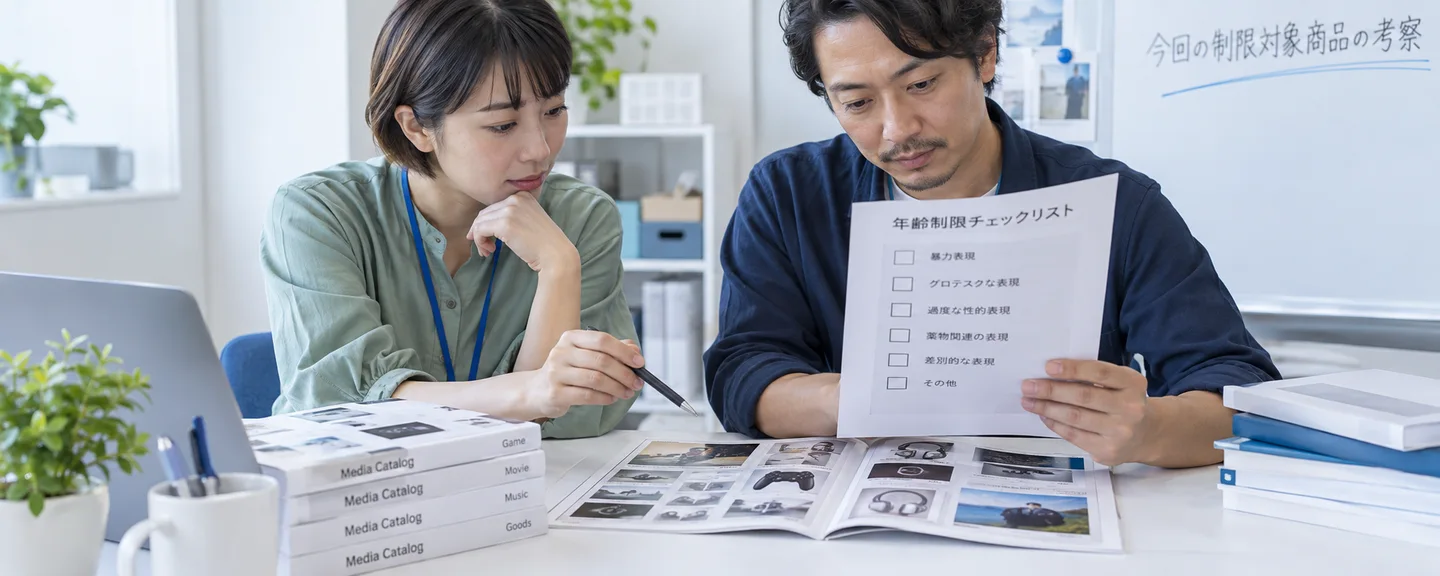
For books, if the product page doesn't let buyers confirm that the performer (model) was 18 or older at the time of filming, Amazon may remove the page. For products containing sexually stimulating images, sellers are asked to verify the performer's age at filming and state clearly, for example in the product description, that the performer was "18 or older at the time of filming." For photo books that aren't designated as adult content, the Help content only says to set the adult flag "according to the adult designation given by the manufacturer or publisher," so confirm both the publisher's designation and what's shown on the screen.
Rights in product images and descriptions
The Amazon Intellectual Property Policy states that you should not upload photos from a third party's website to a product detail page without permission, and requires that you use only images and text you created yourself or for which you have the copyright holder's authorization. You can be subject to enforcement action even if you infringed unknowingly. If a third party makes a claim over a rights infringement involving images or other content, sellers are also obligated to defend and indemnify Amazon (under the Amazon Services Business Solutions Agreement). The Book Content Guidelines likewise touch on the seller's responsibility to warrant that a listing doesn't infringe rights such as privacy or publicity. We cover responding to copyright claims in responding to a copyright infringement claim.
Thinking about portrait rights and the right of publicity
The right that protects the customer-drawing power of a person's name and likeness is generally known in Japan as the "right of publicity." In a ruling on February 2, 2012, the Supreme Court of Japan held that unauthorized use of a person's name, likeness, and the like becomes an unlawful infringement of the right of publicity under tort law when it can be said to be purely for the purpose of exploiting that customer-drawing power, and gave the following categories as examples (the case itself concerned a photo published in a weekly magazine, and the court found no infringement).
- Using the likeness itself as a product meant to be viewed or appreciated (a concurring opinion gave items such as promotional photo cards, or "bromides," as an example)
- Attaching the likeness to a product in order to differentiate it (so-called character merchandise)
- Using the likeness as advertising for a product
Unauthorized bromides or candid photos, merchandise with a photo attached, and product images that use a photo in an advertising-like way could fall into these categories. That said, Amazon's Japanese Intellectual Property Policy has no standalone section on the right of publicity, and the Help content doesn't spell out how it's handled. Separately, Japan's law on preventing and remedying harm from adult video performances lets a performer demand that someone stop publishing material that was made public without a contract, among other remedies. For a specific determination — including how this applies to sellers of secondhand items — check with a lawyer.
Sourcing and condition: bonus items, not-for-sale items, and autographed items
Whether you can list an item, and what condition you can list it as, depends on how you sourced it.
| Product / sourcing situation | Rule |
|---|---|
| Products not manufactured by the maker or copyright holder (reproductions, replicas, duplicated discs, etc.) | Cannot be listed |
| Promotional review copies, samples, videos, and DVDs (including advance copies and pre-proof manuscripts) | Cannot be listed |
| Promotional items, prize items, and freebies | Cannot be listed as "New." List as used and state this clearly in the condition notes |
| Products sourced from an individual (other than a sole proprietor) | Cannot be listed as "New" |
| CDs/DVDs that came with a purchase bonus | State that the bonus is included in the condition details. Otherwise the title may be changed to indicate "no bonus" without warning |
| Missing bonus items, lyric cards, and the like | List as "Used – Acceptable" and explain what's missing |
| Autographed or out-of-print books, CDs, and DVDs | To list as a "Collectible," explain the added value in detail |
Items bought back from fans count as sourced from an individual, so they can't be listed as "New" even if unopened. For not-for-sale items, check the Condition Guidelines to see whether the item falls under the "sample/review copy" or "not for sale" designation, or whether it can be listed as used, as a prize item or freebie. See also reviewing your New/Used condition listings.
Steps to check before listing: 6 steps
Run your check in three stages: whether Amazon allows the product at all, whether it meets the labeling rules, and whether the rights are clear.
STEP 1. Identify what to check based on the type of product
| Type of product | Does Amazon allow it | Labeling rules | Rights |
|---|---|---|---|
| Celebrity photo books, celebrity books, magazines | New listings require prior approval | If the images are sexual, state that the performer was 18 or older at filming | Where the product images came from |
| Idol DVDs | New listings not allowed. Titles requiring age verification can only be listed by sellers 18 or older. Promotional copies are not allowed | Whether the images show exposure or sexual suggestion | Whether the disc is a duplicate |
| Adult DVDs | New listings by sellers are, in principle, not allowed. Only sellers 18 or older may list them | Ethics review number, adult flag | Copyright holder's permission |
| Celebrity merchandise, bromides | Replicas are not allowed | Whether images were taken in-house or are properly licensed | Whether it's an official item (unofficial items risk unauthorized use of a likeness or photo) |
| Lingerie, cosplay, adult goods | Designated browse node only | Adult flag, exposure in images | Permission for the model's likeness |
| Doujinshi and unofficial fan-made merchandise | Cannot be listed without a JAN or ISBN code | If the content is sexual, set the adult flag and state the age | Derivative works without the original creator's or copyright holder's permission cannot be listed |
STEP 2. Check the listing status shown in Add a Product
Search for the product in Add a Product (商品登録). "Not supported" (非対応) means the product can't be listed; "Sell this product" (この商品を出品する) means no approval is needed; and "Apply to sell" (出品許可を申請) means approval is required, with the detailed requirements available under "View restrictions" (制限を表示). Seeing "Sell this product" doesn't by itself mean the listing complies with the Adult Products policy or image requirements. For a product that isn't in the catalog, check a similar product to get a sense of possible restrictions. When applying, you'll generally need documents such as an invoice dated within the past 180 days and clear photos of the product, and review typically takes about 2 to 7 business days. If a product shows "Requirements not met for approval" when you apply to sell, it can't be listed, and that determination can't be appealed. For appeals after your selling privileges have been revoked, see the FAQ below.
STEP 3. Look up requirements in Regulatory Compliance Reference Materials
In Compliance Self-Assessment (コンプライアンスの自己評価), select the marketplace where you sell, then search by product type, ASIN, or keyword; you can then check the requirements through "Show Help Content" (ヘルプコンテンツを表示). For products that are prohibited from sale, this button is disabled. That said, some product types can't be checked this way.
STEP 4. Check an existing listing before piggybacking on it
Amazon asks sellers not to assume a product is allowed just because an ASIN already exists for it. Before piggybacking on an existing listing, check the following.
- Whether the classification (browse node) and adult flag match the actual item
- Whether the images show exposure or sexual suggestion, and whether any photo looks like it may not be properly sourced
- For books, whether the "18 or older at filming" statement or an ethics review number is present
- Whether there is any wording that infringes someone else's privacy
Do not piggyback on an existing listing that has a problem in any of these areas.
STEP 5. Check the images and copy you prepare yourself
Product images must not be nude or suggest nudity (this applies to both models and illustrations). Depictions where sheer clothing reveals private areas, and provocative poses involving two models or a model entangled with the product, are also not allowed, and covering body parts with a decal (a sticker-like image) is not accepted as a fix. For images or videos that include an AI-generated person, add the keyword "contains-synthetic-performer" to the metadata before uploading.
Obscene or provocative wording, language that alludes to pedophilia, and content that infringes someone else's privacy are also not allowed in the title, description, or product specifications (under the Product Detail Page rules), and any field found in violation is excluded from search.
STEP 6. When in doubt, don't list it, and keep a record of your checks
Amazon lists not listing a product when there's doubt about whether it can be sold as an important point to keep in mind. Because selling privileges can change even for a product you were able to list before, keep a record of the date you checked, the screens you looked at, and the basis for your decision. This record also becomes useful material for explaining your review process if you ever need to file an appeal.
If you receive a notification: sorting out which policy it concerns and filing an appeal
Which screen to check and what to submit depends on which policy the notification concerns. Start by using the notification and your Account Health page to confirm the affected product and the name of the policy involved.
| Type of issue | Where to check and respond |
|---|---|
| Restricted Products, Adult Products (such as a missing adult flag) | If it's shown under "Restricted products policy violations," go to Account Health (アカウント健全性) → the Product Policy Compliance (商品規約の遵守) tab → the item in question → "Submit" in the "Next steps" column |
| Intellectual Property (unauthorized photos, non-genuine merchandise) | Follow the guidance in the notification. If you have never listed the product in question, reply to the notification to say so. Remove or replace any image or text you suspect may be the issue, and if you have a relationship with the rights owner, ask them to withdraw the complaint. If you believe a listing was removed in error, submit your reasoning along with an invoice and order number showing authenticity (for a dispute covering multiple warnings, a letter of authorization from the rights owner also works; forwarded emails are not accepted) |
| Obscene images | The "Fix Your Products" (修正) tab in Manage Inventory (商品の管理), under "Content Compliance Issues" (コンテンツのコンプライアンスに関する問題) in the submission status |
| Product Detail Page rules | Check the affected item in the notification on your Account Health dashboard, then fix the title, description, or images (the field in violation is excluded from search) |
For Restricted Products, either submit documents via "Submit," or choose "Appeal Requirements" and explain why the requirements don't apply to you or why you believe the product was identified in error. We cover responding by type in steps for responding to restricted-product warnings and how to sort out intellectual property warnings.

Four points to address in an appeal
An appeal for a Restricted Products violation should address four points: (1) which product violated which policy, (2) the cause of the violation, (3) the steps you took to resolve it, and (4) your measures to prevent it from happening again. Plans of action that contain only an apology and a promise to improve, or a stated cause such as "I just listed a product that was already in the catalog" or "I listed a restricted product," are examples of what gets rejected. Any measure you describe is treated as already in place at the time you submit it, so don't write about something you haven't actually done yet.
Below is a hypothetical sample text, not an actual case. Replace it with the facts about your own business.
[Affected products and policy] We listed 12 sexy lingerie items without the adult flag and in a browse node other than the designated one, in violation of the Adult Products policy.
[Cause] We registered products from a new supplier using the same process as ordinary clothing, and had no procedure for checking whether an item counted as an adult product.
[Corrective action taken] We removed the affected listings and reviewed all SKUs to confirm no other listings had the same problem.
[Measures to prevent recurrence] For new registrations of clothing and general merchandise, the person in charge now checks and records the classification and flag against a checklist, and the item is registered only after the review lead approves it. We review the classification and flag across our entire catalog once a month.
For more on how to write this up, see how to build a plan of action.

What not to do
- Marking the item out of stock and leaving it at that: This does not bring you into compliance with the policy or the law.
- Continuing to sell while believing the determination was wrong: Even if you believe the determination was mistaken, you're advised to end the listing promptly and confirm legal compliance in parallel with filing your appeal.
- Reusing a past appeal or sample text as is: A previous appeal can't be reused, and leaving this article's sample text unchanged won't convey your own cause and corrective actions.
- Altering documents or opening a new account to get around the problem: Any document you submit must be in its original, unmodified format. Creating a separate account to sell and avoid a warning or suspension is also a policy violation. Either one will only make your situation worse.
Building prevention into your internal rules
Amazon calls for appointing at least one person responsible for review, regularly checking your policies and your own catalog — including inventory feeds and automated uploads — and paying close attention to the source and accuracy of documentation when sourcing from anyone other than the manufacturer. A small-scale seller could put this into practice as follows.
What to settle on for your operations
- The person responsible for review (yourself, if you run the business alone) and who to consult when you're unsure about a legal question
- A process for recording your STEP 1–5 checks and registering the item only after the responsible person reviews them
- A log for each image recording who took it and whose permission covers it
- A monthly review of flags and classifications, any products excluded from search, and anything registered automatically
- Regular checks of Performance Notifications and Account Health

Frequently asked questions
Q. Is it fine to list a legitimately purchased photo book as used?
A. Amazon explains that a book or similar item purchased legitimately and lawfully can generally be resold under the doctrine of copyright exhaustion. That said, you still need to separately meet the catalog restrictions, the requirement to state the performer's age at filming, and the condition requirements, and if you're unsure about how this relates to a person's likeness, check with a professional.
Q. Is it safe to list once I've confirmed with Technical Support?
A. Amazon states that it does not pre-review listing information or provide legal advice, and "contact Technical Support if unsure" is not recognized as a valid measure to prevent recurrence. You're expected to have your own review process in place.
Q. Can even official merchandise or a genuine photo book be restricted?
A. Yes. Amazon uses its own discretion to decide whether something counts as an adult product, and even a genuine item can be excluded from search if its image meets the standard for an obscene image, or can fall under a prohibited-listing example if it doesn't meet the adult flag or classification requirements.
Q. If my selling privileges are revoked, can I get them back?
A. In most cases you can appeal the decision, and sellers who effectively address the root cause and prevent it from recurring are said to sometimes be reinstated. There's no guarantee of the outcome. We lay out the process in an overview of the path from account suspension to reinstatement.
Summary
- Restrictions run along the axes of sexual depiction, age, rights, and catalog creation — not gender
- Adult goods, sexy lingerie, and cosplay can only be sold in the drugstore store's designated browse nodes, on the assumption that the adult flag is set. Adult media products such as DVDs and books are limited to items meeting requirements such as an ethics review number and a stated age at filming
- New catalog listings for items such as celebrity photo books require prior approval, and new listings for items such as idol DVDs cannot be created at all
- Use only images that were taken in-house or properly licensed, and check questions about a person's likeness with a professional
- If you receive a notification, sort out which policy it concerns and prepare an appeal that addresses the four points
When you're unsure about a product, hold off on listing it, and consider consulting a professional early if needed.
Need help with restricted products, such as celebrity or adult items?
We'll assess your prospects for reinstatement at no cost. Consultations are free, as often as you need.
 Free consultation, 24/7
*This article provides a general explanation. The appropriate response in individual cases depends on the circumstances.
Further reading
 Responding to Amazon copyright complaints: identifying content and checking permissions Read article →
 Understanding Amazon intellectual property warnings: rights involved and supporting evidence Read article →
 Reviewing your Amazon Account Health Rating: warnings and improvement priorities Read article →