This guide is for sellers who were notified of a suspension over suspected inauthenticity and asked for invoices, but don't have documents that meet the requirements. It covers checking the notice, the invoice requirements in Amazon's Japanese help pages, reviewing the documents you have, what to do (and what to avoid) when documents fall short, how to write the appeal, and how to manage sourcing after reinstatement.
What an "authenticity review" is: the underlying policy and possible actions
"Authenticity review" (真贋調査) is a term sellers use informally; Amazon's official help has no procedure by that name. The main basis is the Japanese help page "Amazon Anti-Counterfeiting Policy" (Amazon偽造品の取り組み), and the help page on invoice requirements refers to the relevant notices as "product quality and reliability Performance Notifications." Suspension emails that sellers have posted on the Seller Forums in the past include examples of the wording "suspected inauthentic items."
This article is based on Amazon's help pages and policies and on Japanese law as of September 2026. Because policies and on-screen labels can change, check the actual notice and the latest help pages as well.
Key points of the policy
- Only authentic products may be sold on Amazon, and sellers and their suppliers are responsible for sourcing, selling, and shipping only authentic products
- Violations can result in the removal of selling privileges, withholding of funds, and destruction of inventory held by Amazon. Inauthentic inventory may be destroyed at the seller's expense
- If you sell inauthentic products, your funds will not be disbursed until Amazon can confirm that buyers received authentic products. Payments may also be withheld if Amazon determines that the account is being used to sell inauthentic products, commit fraud, or similar
- Even without a report from a rights owner, Amazon's own review may remove listings it considers suspicious
How much weight it carries in Account Health
The Amazon Anti-Counterfeiting Policy is one of the policies covered by the Account Health Rating (アカウント健全性の評価, AHR). In Amazon's official severity examples, items found to be counterfeit or pirated through a test buy are "Critical" (重大), while counterfeit reports from buyers and similar cases are "High" (高). A Critical violation drops the score to 0, with a three-day grace period before suspension. If fraudulent, deceptive, or illegal activity is suspected, the account may be suspended immediately regardless of the score.
Professional sellers who maintain a high AHR may be eligible for Account Health Assurance (アカウント健全性アシュアランス), under which the account is not suspended as long as they contact Amazon within 72 hours of Amazon reaching out and cooperate to resolve the issue (unless Amazon determines they are involved in fraud or similar activity). You can request a call from the dedicated team through "Call me now" (今すぐ電話がほしい) on the Account Health page. How the score works is covered in How to check your Account Health score.

What to check first when you receive the notice
Before sending any documents, confirm what is affected and what is being requested.
STEP 1. Check the violation and affected items in Account Health
Open Account Health (アカウント健全性) in Seller Central and check the violation on the Product Policy Compliance (商品規約の遵守) tab. If it isn't shown there, check Manage Inventory (在庫管理) for suppressed listings and Performance Notifications (パフォーマンス通知) for details.
STEP 2. Write down the list of affected ASINs and the submission deadline
According to Amazon's official guidelines, the list of products under review is at the bottom of the first notice, and you also need to check the submission deadline. For some products, invoices covering the past 365 days are required. Because deadlines and required documents can differ from notice to notice, write down each item one by one so nothing is left out of your submission.
STEP 3. Identify which kind of notice it is
Even when the concern is the same "suspected counterfeit," where to check and how to approach what you submit differ depending on what triggered it. If the notice doesn't state the trigger, judge from the violation name in Product Policy Compliance and the wording of the notice, and don't fill in anything you're unsure about with guesses.
| Trigger | Classification in official materials | Key points for your response |
|---|---|---|
| Complaint from a rights owner | Example of "High" severity | If you believe it is a mistake, reply to the notice and provide invoices or order numbers that show authenticity. If you have an established relationship with the rights owner, such as a license or distribution agreement, you can ask them to retract the complaint |
| Counterfeit report from a buyer | Example of "High" severity | Match the products in the affected orders against your sourcing records, and gather evidence in line with the invoice requirements |
| Found to be counterfeit in a test buy | Example of "Critical" severity | Score drops to 0, with a three-day grace period before suspension. Be ready for a call from an Account Health Specialist |
| Investigation of FBA inventory | Policy on investigations of non-compliant inventory | Inventory may be put on hold, and you may be asked to submit information such as proof of authenticity by a deadline |
Make sure to confirm your emergency contact phone number in Notification Preferences (通知設定). For organizing your response to complaints from rights owners, see Organizing documents when accused of trademark infringement or counterfeits, and for identifying the affected ASINs, see Organizing affected ASINs and documents for an authenticity review.

Amazon's invoice requirements: what the Japanese help page says
The Japanese help page "Invoice requirements for policy violation appeals" (ポリシー違反の申し立てに関する請求書の要件) defines an invoice as a document issued by the supplier that itemizes the products received and states the terms of sale for a completed transaction, and requires the following information.
| Item | Requirement (summary) |
|---|---|
| Issue date | Clearly shows a date within the 365 days before you received the Performance Notification |
| Quantity | Covers the sales quantity over the past 365 days and the inventory on hand for each ASIN (see below) |
| Products covered | Shows sales records for each ASIN tied to the violation. If multiple products are listed, you may highlight the relevant ones |
| Product codes | Product name, model number, UPC, or other details that can be verified online |
| Supplier contact information | Name, phone number, address, website, and so on |
There are also the following conditions.
- It must be an original, unaltered document. Pricing information may be removed, but all other information must be legible
- The format must be PDF (.pdf) or an image (.jpg, .png, .gif)
- It must record a completed transaction that has shipped
- Amazon may contact the supplier to verify it
- The supplier must have a "robust web presence" that can be verified through government sources such as a tax registration number, or through the brand's website or business directories
Documents that are not accepted (examples from the Japanese help page)
- Documents sent before a transaction is completed, such as quotes and pro forma invoices
- Invoices issued by the seller themselves, or invoices where the supplier and buyer appear to be the same entity
- Altered invoices, and invoices in editable formats such as Excel (.xlsx) or Word (.docx)
Review the documents you have against the requirements
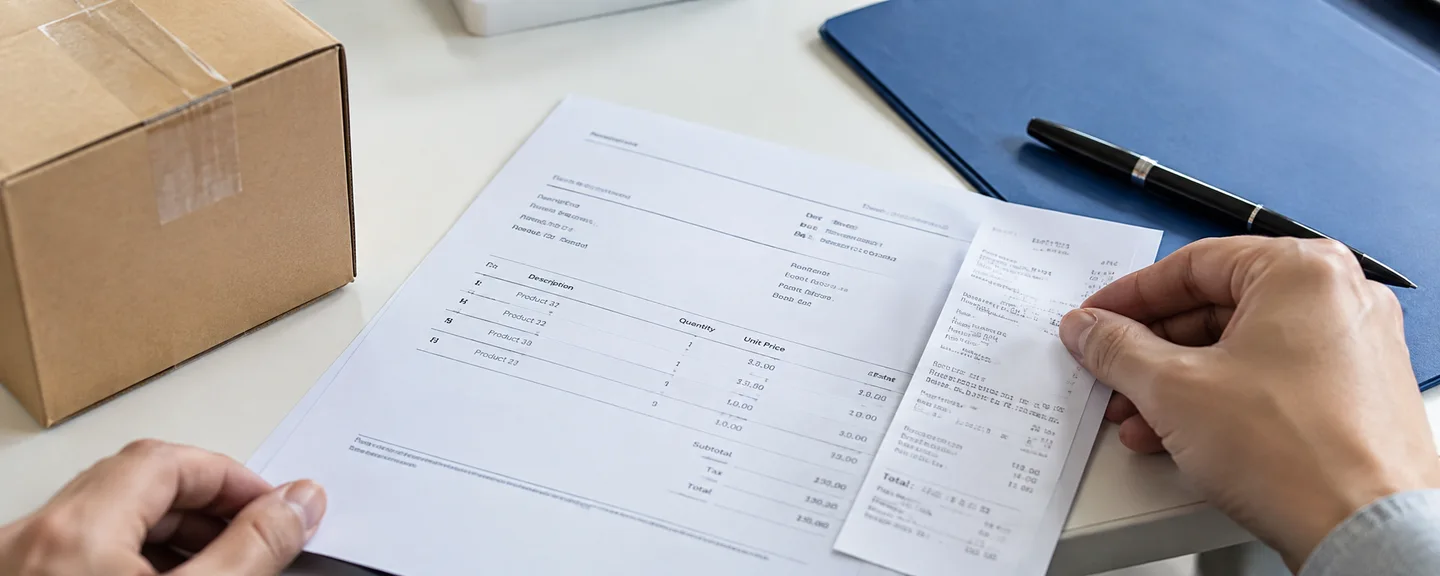
"I don't have an invoice" can mean you have no documents at all, or that your documents are missing some of the requirements, and what you can do differs between the two. Arrange the documents you have in the order of the transaction's stages, and check for the items most often missing. (The table is a guide for finding gaps, not an indication of whether a document will be accepted.)
| Document you have | Requirements it often lacks | How to fill the gap within the facts |
|---|---|---|
| Quote or order confirmation email | Record of a completed transaction (documents from before the transaction was completed are listed as not accepted) | Check whether a final invoice was issued |
| Delivery slip | Terms of sale for a completed transaction | Ask the supplier whether an invoice exists for the same transaction |
| Invoice issued by the supplier (manufacturer, wholesaler, etc.) | Issue date within 365 days, quantity per ASIN, product codes, supplier contact information and web presence | Reconcile quantities ASIN by ASIN (see below) |
| Store receipt or handwritten receipt | Buyer information, and a product name from which a product code can be identified (often abbreviated or listed simply as "goods") | Ask whether the store can provide formal documents to fill the gap (see below) |
| Transaction screens from flea market or auction apps | A supplier verifiable as a business. Products sourced from individuals (other than sole proprietors) cannot be listed as "New" | Also check whether the condition you listed was correct |
| Documents you created or modified yourself | Invoices issued by the seller or altered invoices are listed as not accepted | Do not submit them. Do not create or modify documents |
It is normal for receipts not to show the buyer's name. Even under Japan's Qualified Invoice System, the "simplified qualified invoice" (適格簡易請求書) issued by retailers and similar businesses doesn't need to include the recipient's name. Even if a receipt is correct for tax purposes, it is likely to fall short when compared with Amazon's requirements and the "buyer details" listed in its due diligence help page, and we could not find any official statement on whether such receipts are accepted.
Reconcile quantities for each ASIN
Quantity is the point most often overlooked. Even a genuine invoice doesn't meet the requirements if it doesn't cover the sales quantity over the past 365 days plus the inventory on hand. Check each ASIN as in the hypothetical example below (not an actual case).
| ASIN | Units sold in the past 365 days | Current inventory (including FBA) | Quantity on invoices within 365 days | Difference |
|---|---|---|---|---|
| Product A | 40 | 10 | 60 | 10 to spare |
| Product B | 25 | 5 | 20 | 10 short |
| Product C | 12 | 8 | 0 (sourced more than 365 days ago) | 20 short |
For long-held inventory sourced more than 365 days ago, like Product C, or ASINs whose combined sales and inventory exceed the invoiced quantity, like Product B, plan how to handle them on the assumption that they cannot meet the requirements. The Japanese help page does allow you to highlight the relevant products, but do not write anything on the invoice other than highlighting, such as adding quantities or product names.

Authenticity reviews for products sourced from retail stores or flea market apps, or as used items: checking your sourcing documents for retail arbitrage and resale
This section covers what to check if you list products bought at retail stores or on flea market apps, or products sourced as used items (so-called retail arbitrage or resale). It assumes you have received a notice that your listings or your account have been suspended over suspected inauthenticity.
Amazon's help pages do not explicitly state how Amazon treats store receipts or records of transactions with individuals as invoices. Whichever way you sourced the products, compare the records you have with the invoice requirements described above one item at a time, and identify what is missing first. Whether they are accepted is decided by Amazon's review. Checks you can make at the sourcing stage are summarized below in "Preventing the same problem after reinstatement."
Note that how Amazon's policies treat sourcing products bought on Amazon and reselling them is a separate issue from the invoice requirements. It is covered in the question "Is buying products on Amazon to resell a violation in itself?" in checking and inquiring about order violations on a buyer account. If you are asked for listing approval (prior approval), that is a condition separate from whether the product is genuine, and the procedure is also separate from an authenticity appeal. See how to check brand information and prior approval.
Amazon Seller Reinstatement Support (not an official Amazon contact channel), which publishes this article, also accepts consultations on listing restrictions and on applying for listing approval. Our fees are the same for every engagement, and you can check them on our pricing page.
If you sourced products from stores and have receipts: checking the addressee and product name
What store receipts and handwritten receipts often lack is buyer information and a product name from which a product code can be identified (see the table in "Review the documents you have against the requirements" above). Do not add the addressee, product name, or quantity yourself after receiving them. Invoices are required to be original, unaltered documents.
How to check whether a store can provide receipts showing the addressee and product names, or a purchase history, is covered in STEP 2 of "What to do when invoices are missing or insufficient" below. The same STEP 2 also explains that a newly issued document doesn't fit the literal wording of the issue-date requirement. Don't hide products for which you can't gather documents that meet the requirements; explain how you are handling each ASIN (STEP 3 below). For an example of how to write about a product for which only a receipt remained, see the sample in "Writing basics" below.
How receipts without the buyer's name relate to tax law and Amazon's requirements is explained in the paragraph below the table above. Also see "If you only have a retail receipt" in organizing the documents requested for authenticity reviews.
If you sourced products from flea market apps or individuals: verifying the supplier and the listing condition
For products bought from individuals on flea market apps, what you are most likely to have is a record of the transaction screen. One of the invoice requirements is that the supplier's existence can be verified through government sources or other information (the "robust web presence" described above). Records of transactions with individuals may not meet this requirement.
Also, products sourced from individuals (other than sole proprietors) cannot be listed as "New," even if they are unopened. If you listed them as New, that is also an error in your condition setting, separate from the authenticity issue. Also check the next part, "If you sourced products as used items."
If you sourced products as used items: telling an authenticity issue apart from a "suspected used" notice
Even for products listed as used, reproductions and counterfeits cannot be listed in any category. If you receive an authenticity notice, first check the notice for the affected ASINs and the documents requested, even if the products are used (see "What to check first when you receive the notice" above).
On the other hand, products you listed as New may receive a notice questioning whether they are actually used. This is treated as a violation of the Condition Guidelines, and the question is whether the item is in a state in which it can be listed as New. An authenticity notice asks whether the product is genuine, and the documents you need to prepare are also different. Use the violation name in the notice to determine first which of the two applies. For a condition notice, see responding to a "suspected used item" notification, and for how to decide the condition category when listing, see how to review your new and used condition settings.
What to do when invoices are missing or insufficient
First confirm what you must not do, and then work through the options available to you in order.
STEP 1. Never create or modify documents
Creating an invoice in the supplier's name or changing dates or quantities may fall under "Forgery of Private Documents" (Article 159) of Japan's Penal Code. Submitting documents from a different transaction as evidence for these products may also count as "misleading" conduct, which the Seller Code of Conduct prohibits. Amazon's US anti-counterfeiting policy explicitly states that submitting documents edited in any way other than pricing, or misleading documents, is a violation, and the Japanese help page also lists submitting forged documents as a reason for destroying inventory. Continuing to sell through another account while suspended also violates the same Code of Conduct, which in principle allows one account per selling region. For legal questions, consult a lawyer. If you have been told your documents are forged, see What to do when accused of forged or altered invoices.
STEP 2. Ask whether the supplier can issue formal documents
For the actual transactions, ask whether the supplier itself can issue formal invoices. First, check whether you can get a reissue (a copy of the original) of the invoice from the time of the transaction. A newly issued document will have an issue date after you received the notice, so it doesn't fit the literal wording of the requirement, "an issue date within 365 days before receiving the notice." We could not find any official statement on how Amazon evaluates reissued or later-issued documents.
When you ask, confirm whether the document can include the supplier's official name, address, and phone number; the transaction date; the product name and model number (such as the JAN code); the quantity; and the buyer's (your company's) name. Some stores can provide receipts addressed to you with product names, or members' purchase histories, even for in-store purchases (this varies by store, and whether they are accepted is a separate question). Do not ask for anything that differs from the facts, such as backdating the issue date to the time of the transaction, or incorrect quantities or product names.
STEP 3. Separate the ASINs you can prove from those you can't
Based on your quantity reconciliation, separate the ASINs that have documents meeting the requirements from those that don't. As the official guidelines say, don't hide the ASINs you can't prove; be ready to explain how you are handling each one.
STEP 4. Deal with the listings and inventory for ASINs you can't prove
Stop listing the ASINs you can't prove, and also check whether any other products from the same supplier remain. If you have FBA inventory, check the hold email and the instructions in the notice. According to Amazon's help, you can request removal or abandonment only for inventory determined to comply with policy, and for inventory under investigation, submitting information by the deadline may have to come first. If you don't provide the information by the deadline, or the products are determined to be non-compliant, the inventory may be destroyed immediately.
The FBA Service Terms (F-7.2) of the Business Solutions Agreement provide that, for inventory deemed unfulfillable, Amazon may dispose of it if you don't give return or disposal instructions within 30 days (or within the period set by policy) of being notified that removal is required for reasons such as account suspension. They also provide that Amazon may dispose of it immediately if the reason is involvement in fraud or illegal activity, so don't miss the deadline in the notice.
STEP 5. Identify the root cause as it actually is (example: unverifiable suppliers)
The official guidelines give "unverifiable suppliers" as an example of a root cause. If the reason you can't gather documents lies in how you sourced, acknowledge that fact and show specifically how you have changed the way you choose suppliers. Note, however, that explaining preventive measures does not remove the need for supporting documents.

How to write and submit the appeal (reinstatement request)
Submission process
- For listing-level suspensions, open the violation on the Product Policy Compliance tab in Account Health and submit an appeal following the instructions on the page (in some cases you can resolve it by fixing the listing)
- For account suspensions, create your appeal from "Reactivate your account" (出品用アカウントの再開) at the top of the Account Health page, following the instructions (you may be asked to answer questions or provide supporting documents)
- After clicking "Submit" (送信), wait for the email with the review result. If additional information is requested, submit it through "View Account Health requests" (アカウント健全性の要請を見る)
- If an appeal containing invoices is rejected, check the Performance Notification for the reasons it wasn't accepted (as the Japanese help page advises). Don't resubmit the same documents unchanged; fill the gaps that were pointed out before submitting again
Note that Amazon's help says it can take up to about two days to respond to an appeal, but this is not an indication of how long reinstatement will take.
Writing basics (key points from the official guidelines)
- Write factually, clearly, and concisely. Don't include introductions to your products or business, emotional language, or information about other cases
- Identify the root cause, and show the actions you took with details, dates, and related documents
- Provide evidence or explain how you are handling every product and ASIN under review
- Highlight important parts such as ASINs, supplier names, and terms of the transaction
Below is a sample outline for a case where some ASINs don't have invoices that meet the requirements. It is a hypothetical example, not an actual case, so rewrite it to fit your own facts and dates. If you run the business alone, replace the steps with procedures you can actually keep up, such as a checklist of items to verify or a method for keeping records.
Of the three ASINs listed in the notice, we are attaching invoices issued by the supplier for two (with the relevant ASINs and quantities highlighted). The remaining one was purchased in person at a retail store, and we received only a receipt. The receipt does not show the buyer, and the product name is abbreviated with no product code, so we were unable to provide documents linking it to the ASIN in question.
The root cause was that we had no procedure for verifying the supplier's legitimacy and the contents of the documents when sourcing.
As corrective action, we stopped listing the ASIN in question on [Month] [Day], and handled the FBA inventory according to the instructions in the notice. Since [Month] [Day], we source only from suppliers whose business information and web presence we can verify, and we have changed our procedure so that a person other than the purchasing staff checks the required items on each invoice before a product is listed.
For details on how to structure it, see How to structure a plan of action, and for the overall process from suspension notice to appeal, see From account suspension to reinstatement request.
What happens to your funds during the investigation
If Amazon determines there is a risk, funds are generally held for 90 days, and the hold is extended if the investigation continues. If Amazon determines the purpose was to list counterfeits or similar, funds are held until it is confirmed that there is no problem. If the hold isn't lifted through an appeal, for example, you can file a dispute requesting payment with the contact listed in the help page "Policy on releasing held funds" (売上金留保の解除に関するポリシー) once 60 days have passed since the hold date, and you may be asked for sourcing documents at that point too. Because the timing of payment is not guaranteed, leave some room in your cash flow. For details, see How to check your funds after a suspension.
Preventing the same problem after reinstatement
Build the points from Amazon's help page "Use due diligence to select reliable suppliers" into your sourcing and record-keeping, adapted to methods available in Japan.
Checks when choosing suppliers
- Whether the supplier is an authorized distributor for the brand, and whether it can provide a letter of authorization or invoices showing where the inventory came from
- Whether invoices include the supplier's and buyer's details, the issue date, product descriptions, and quantities purchased
- Check the supplier's registration number on the National Tax Agency's "Qualified Invoice Issuer Publication Site" (適格請求書発行事業者公表サイト) (this is not required by Amazon; it is one example of a method available in Japan). It only tells you whether the business is registered and does not prove products are authentic, and some businesses have no number, so also check the address, contact details, and website
- Make it clear in your contract that the supplier is responsible for inventory that receives legitimate authenticity complaints
Keep an evidence ledger
Store invoices in a way that lets you search by ASIN, purchase date, and quantity. The retention periods under tax law are longer than the period Amazon requires invoices to cover (the past 365 days): corporations must generally keep records for 7 years (10 years for fiscal years with a loss under a blue tax return, among other cases). For sole proprietors, invoices, delivery slips, and similar documents must generally be kept for 5 years for income tax purposes, but businesses taxable for consumption tax that claim input tax credits must generally keep their books and invoices for 7 years. Including sole proprietors filing blue tax returns, check the period that applies to you with the National Tax Agency's guidance or a tax accountant. Secondhand goods dealers are also required to keep transaction records for 3 years; ask your local police station whether unused items purchased in stores count as secondhand goods.
Items to check before listing
- You aren't listing products sourced from individuals (other than sole proprietors) as "New"
- Parallel imports are listed as "parallel imports" (並行輸入品) on a separate product detail page from the regular product (restricted or prohibited in some categories)
- The product isn't a branded item priced far below the market rate (goods that infringe trademark rights are prohibited from import under the Customs Act)
- Your purchase quantities and expected sales stay within what the invoices you have can account for
For reviewing your day-to-day management, also see Reviewing your operations after reinstatement.
Frequently asked questions
Q. If all I have are receipts or handwritten receipts, is there any point in submitting them?
A. There's no single answer. Compare them with the requirements in the Japanese help page (issue date, quantity, product codes, supplier contact information, and so on) to see which items are missing, and ask the supplier for any information that can fill the gaps. Adding anything yourself violates the requirement that the document be "original and unaltered."
Q. The invoice help page says Amazon may contact the supplier. Should I tell my supplier anything in advance?
A. Letting the invoice issuer know they may be contacted for verification, and asking them to answer truthfully, makes it less likely that verification stalls because the contact was overlooked. You must not dictate what they say or ask them to give an explanation that differs from the facts.
Q. The letter of authorization help page lists "receipts from physical stores" as an example of documents that aren't accepted. Does that mean they won't work as invoices either?
A. That list gives examples of documents not accepted "as a letter of authorization (LOA)"; it doesn't determine whether they are acceptable as invoices showing authenticity. For invoices, check against the requirements in the Japanese help page described above.
Q. Without invoices, can I get reinstated by writing detailed preventive measures?
A. There is no official statement that preventive measures can substitute for supporting documents. The basic approach is to explain factually how you are handling the ASINs you can't prove, the root cause, and the actions you have taken; the outcome depends on Amazon's review.
Q. What happens if I don't respond to an authenticity review notice?
A. In the official materials, the removal of selling privileges, the withholding of funds, and the destruction of inventory are listed as actions for not complying with the Anti-Counterfeiting Policy (see "Key points of the policy" above). It is also stated that selling products that are not genuine can lead to suspension or closure, including of related accounts. FBA inventory under investigation may also be destroyed if you don't provide information by the deadline (STEP 4 above). On the other hand, Amazon states that even with a "Critical" violation, your account will not be suspended if you address it within the three-day grace period (except where fraudulent, deceptive, or illegal activity or similar is suspected), so first check the affected ASINs and the deadline in the notice. We cover this in detail in organizing affected ASINs and documents for an authenticity review, including the fact that simply stopping your listings does not make the violation disappear.
Q. Can a return or a report from a buyer trigger the notice?
A. Counterfeit reports from buyers are given in the official materials as an example of "High" severity (see the table in "Identify which kind of notice it is" above). However, what triggered an individual notice, and how many reports it takes to lead to action, are not made public. In your appeal, don't write guesses about what the trigger was; first match the order details for the affected ASINs against your sourcing records. For products returned through FBA, you can also check the movement and timing of returns in the Inventory Ledger report (how to read it is covered in responding to a "suspected used item" notification).
Q. Are the same documents required on overseas Amazon marketplaces (when exporting)?
A. The invoice requirements in this article are what the Japanese help page says. The US help pages also contain guidance not found in the Japanese version (such as no more than 10MB per file), and there is also a separate agreement for each country or region. In one example notice posted on the US forums, the suspension continued because the appeal did not explain the possible intellectual property infringement sufficiently, and the seller was asked either to show authenticity with documents such as invoices or letters of authorization, or to resubmit a plan of action that digs deeper into the root cause. Check the notice and the help pages of the store where you sell for any specified document formats or languages. We explain how to identify which region and which store were suspended in how to check seller account suspensions on overseas Amazon.
Summary
A so-called authenticity review is an informal term for situations in which you are asked to confirm the authenticity of products, based mainly on the Amazon Anti-Counterfeiting Policy, the intellectual property policies, and similar. The less complete your invoices are, the more important it is to check the following.
- Check the list of affected ASINs and the submission deadline in the notice
- Compare the documents you have with the requirements in the Japanese help page and identify what is missing
- Don't create or modify documents; ask whether your supplier can issue formal documents
- Separate the ASINs you can prove from those you can't, and explain the root cause and your actions with dates
- After reinstatement, prevent the same problem by verifying suppliers and keeping an evidence ledger
If you're unsure how to proceed, consider organizing your situation and consulting a specialist early.
Work toward reinstatement after an authenticity-review suspension
We'll assess your prospects for reinstatement at no cost. Consultations are free, as often as you need.
 Free consultation, 24/7
*This article provides a general explanation. The appropriate response in individual cases depends on the circumstances.
Further reading
 When Amazon requests proof of authenticity: organizing ASINs and supporting documents Read article →
 When Amazon flags a forged or altered invoice: verifying facts and using genuine documents Read article →
 Amazon trademark and counterfeit allegations: organizing sourcing evidence and rights information Read article →