This article is for Amazon sellers who have had a listing removed, received a warning, or had their account suspended over a "counterfeit" or "trademark infringement" complaint. It walks through how to tell whether the complaint targets the product itself or how the listing page is presented, what invoices need to show, how to check the rights involved, which response route to take, and how to prevent the problem from recurring.
How Amazon's Policies Treat "Counterfeit" Products
The Help page "Amazon's Anti-Counterfeiting Policy" states that it is the seller's and the supplier's responsibility to source, sell, and ship only authentic products, and that a violation can lead to account suspension or closure, disposal of fulfillment center inventory at the seller's expense, and withholding of payouts.
The Help page "Amazon's Intellectual Property Policy" defines "counterfeit" as a form of trademark infringement: the unlawful reproduction of a registered trademark, or a mark that closely resembles one, on a product or its packaging that was not provided by the trademark owner. In other words, this kind of complaint questions whether the product itself is genuine.
This article is based on Seller Central Help content, the text of relevant statutes, and materials published by Japan Customs, as of September 2026. Policies and on-screen labels can change, so please also check the latest Help pages and any notifications you receive.
Visual Similarity, and Complaints That Can Arise Even for Genuine Products
Amazon explains that a product is not counterfeit merely because it looks similar to another, as long as it does not misuse a registered trademark. That said, a similar-looking product can still run into issues under design-right law or the Unfair Competition Prevention Act (see also how to check a design-right infringement warning). Conversely, even a genuine product can draw a complaint if its title, images, or brand field create confusion about its source — Amazon explains that unauthorized use of a trademark generally counts as infringement when it is likely to cause this kind of confusion about where the product comes from. Amazon also states that warnings or account restrictions can be imposed even when the infringement was unintentional.
What to Check First When You Receive a Notification
Open the Details of the Violation in Account Health
On the Account Health page, click "View All" under the Product Policy Compliance tab to see the history of removed listings and images, the current status, and the next steps for reinstatement. If nothing shows up there, look for the suspended listing under Manage Inventory, and check the details of the removal in Performance Notifications. For how to check your score, see also how to check your Account Health score.
Items to note down from the notification and screen (leave "unknown" for anything missing)
- The affected ASIN/SKU and the date you received the notification
- The type of complaint (counterfeit, trademark infringement, or other intellectual property right)
- What the complaint targets (the product/packaging, or the product detail page)
- The rights owner's name and contact details, if listed
- The action requested, whether a deadline is stated, and the severity of the violation
Checking Severity, and the Three-Day Grace Period for "Critical" Violations
Under the Account Health Rating (AHR), a product determined through a test buy to be counterfeit or pirated is one example given for "Critical" severity, while a valid infringement notice from a rights owner or a buyer's report of a counterfeit product is an example of "High" severity. Even a single Critical violation can trigger suspension: your rating turns red with a score of 0. According to the Help FAQ, there is a three-day grace period before suspension — if you resolve the issue within that window your account will not be suspended, and if you don't, it will remain suspended until you complete an appeal from the Product Policy Compliance dashboard. This three-day period is described for Critical violations (including when the limit on repeat violations is reached), and Amazon does not state that the same period applies to High-severity violations such as a rights owner's notice. Because you may receive a phone call during this period, also check the emergency contact registered under Notification Preferences.
However, the policy text also says that if violations of the same policy reach a set limit within 180 days, your account may be suspended immediately, so don't count on the three-day grace period; act early. For higher-severity violations, the limit may be reached with a second violation, and infringement-related policies are described as having a low threshold. Because the limit differs from what was stated in materials predating the policy that took effect on July 23, 2025, it's best to identify the cause the first time a violation occurs.
Identifying What the Complaint Targets: the Product Itself or the Product Page
When a rights owner reports an issue to Amazon, the reporting process asks them to indicate whether the infringement involves the product or its packaging, or the images and text on the product detail page.
| What to check | Product/packaging issue | Product detail page issue |
|---|---|---|
| What's in question | Whether the product you sold is genuine (authenticity) | How the trademark is used in images, text, the brand field, and similar elements |
| Typical situations | A buyer reported it as counterfeit, or authenticity was questioned through a test buy (see also how to respond when you receive an authenticity check) | Unrelated logo images, or compatible-product wording that emphasizes similarity to another brand |
| What you'll mainly need | An invoice or order number showing authenticity | A record of the corrected page content, and a Letter of Authorization (LOA) if required |
This distinction is a guideline based on the US Help pages; it is not presented in the same form on the Japanese Help pages.
Note that a rights owner can also file a report against a specific seller's listing offer alone; in that case, the product detail page and the ASIN are said to remain in place. If the page still exists but only your listing has disappeared, it may be your product itself — rather than how the page is presented — that's being questioned. Another clue: filing a report about a specific seller's trademark infringement through the report form is said to require a test purchase.

Self-Check When the Product Page Is the Cause
If your listing has been suppressed from search results over a suspected trademark infringement, Help outlines the following steps to check it.
- Search for the ASIN under Manage Inventory, then open the Edit Product Info page from Edit
- Check every field and image for a trademark or logo that does not represent the product you're selling — for accessories, also check how compatibility is worded — then click Save
- If the listing is still suppressed after waiting 24 hours, contact Technical Support from Product Policy Compliance
If you can't find the ASIN under Manage Inventory at all, that is said to mean it has been removed from your Seller Central account, and for a reinstatement review, Help directs you to relist the product through the standard listing process and then contact Technical Support. This is covered in more detail in how to check a removal made over a suspected trademark infringement.
Organizing Your Sourcing Documents: What Invoices Need to Show
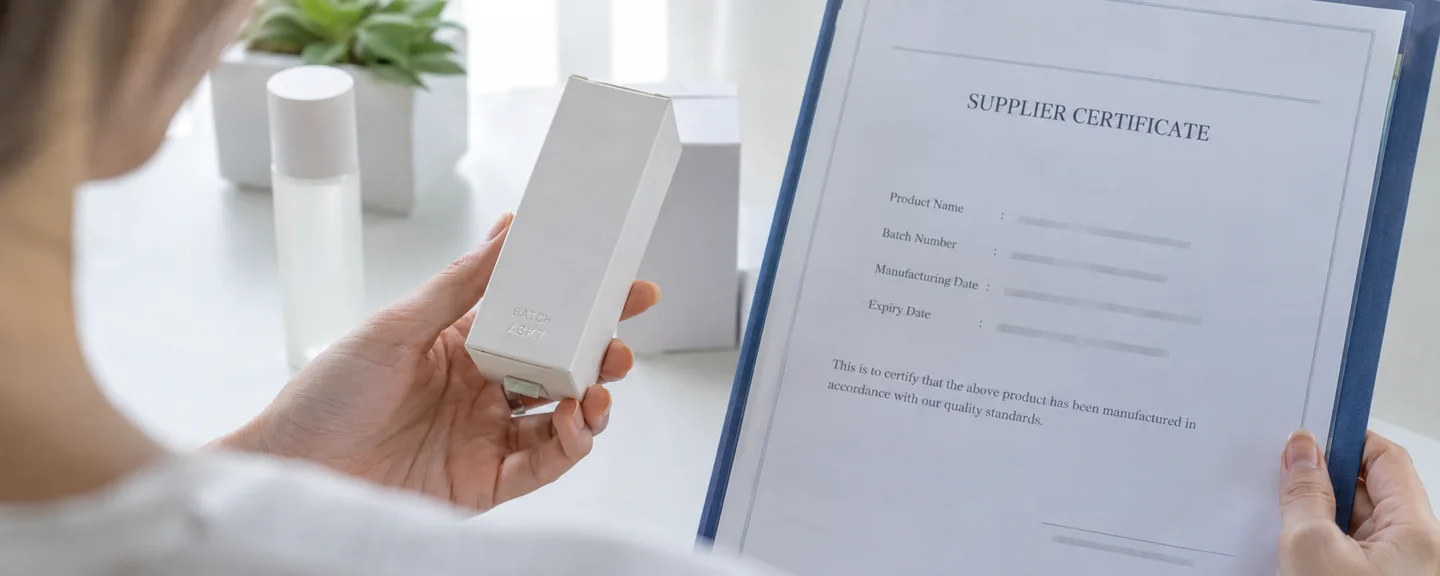
The core document for showing authenticity is your purchase invoice. The Help page "Invoice Requirements for Policy Violation Appeals" calls for the following elements.
Five elements to check on an invoice
- An issue date, clearly shown, that falls within the 365 days before you received the Performance Notification
- A quantity large enough to cover your sales over the past 365 days plus your current inventory on hand
- The product for each affected ASIN recorded on the invoice (you may highlight the relevant entries)
- A product code you can verify online, such as the product name, model number, or UPC
- The supplier's contact information — name, phone number, address, website, and so on
The invoice must also be an unaltered original, legible apart from the price, in PDF, JPG, PNG, or GIF format, and for a transaction that was completed through shipment. Your supplier is expected to have verifiable public information, such as a tax registration number, and an existence that can be confirmed on a brand's website — Amazon may contact the supplier directly to check. Quotes and pro forma invoices, invoices you issued yourself, altered invoices, and editable formats such as Excel or Word are not accepted for review.
Checkpoints by Sourcing Route
| Sourcing route | Records you're likely to have | What to check |
|---|---|---|
| Manufacturer, authorized distributor, or wholesaler | Invoices, delivery notes, transaction agreements | Whether all five elements are present and the quantity covers your sales history and inventory |
| Parallel imports from overseas | Invoices from the overseas supplier, import-related documents | Whether your supplier's existence can be confirmed, and whether you can account for the situation using the three conditions explained later in this article, under "For Parallel-Imported Products" |
| Retail purchase from a store or online shop | Receipts, order confirmation emails | The contact information or quantity shown may not meet the requirements |
| Purchase from an individual or a flea-market app | Records from the transaction screen | May not meet the requirement that the supplier's existence be verifiable |
Help does not explicitly state how receipts or transactions with individuals are treated. If your documentation is insufficient, see also what to check when you don't have an invoice.
Sorting Out the Rights Involved: Confirming Whose Right, and Which Right
Checking Registration Details on J-PlatPat
You can check a trademark's registration status free of charge through the Patent Information Platform (J-PlatPat), run by INPIT (the National Center for Industrial Property Information and Training). If the notification includes a trademark number, use Trademark Number Search; if not, use Trademark Search with the brand name. Confirm the following points.
- Whether the registered owner's name matches the rights owner named in the notification
- Whether the product you're listing falls within the designated goods or services
- The term and renewal status (a trademark right lasts 10 years from the date of registration and can be renewed)
Putting the Relationships on a Single Diagram
Write down the Japanese trademark owner, the overseas brand headquarters, the authorized import agent, the wholesaler, and your own company, then draw lines connecting them to show the product's route and whether authorization exists at each step. Next to each party, note the registration number and rights owner name you confirmed on J-PlatPat, the invoice date and number, and whether a contract or authorization document exists. Any point where the line breaks — where you don't know who supplied your supplier, or there's no written authorization, for example — marks a gap in your explanation or documentation. This also helps you avoid asking the wrong party for a retraction.

For Parallel-Imported Products
Amazon's policy is not to accept notifications about parallel imports between Japan and the US as intellectual property infringement. This, however, only concerns how notifications are handled on Amazon. For enforcement at the border, Japan Customs states that a product can be treated as infringing goods, even if it is otherwise identical to the genuine article, if it does not qualify as a lawful parallel import, and Customs treats a parallel import as not infringing trademark rights only when it satisfies all three of the following conditions.
- The trademark was lawfully affixed by the foreign trademark owner (or a party licensed to use it)
- The foreign and Japanese trademark owners are the same person, or are in a relationship that can be regarded as legally or economically equivalent to being the same person, so that the mark indicates the same source
- The Japanese trademark owner is in a position to control quality, directly or indirectly, and there is no substantial difference in the quality that the registered trademark guarantees
When you list the product, set the selling format to "JP Parallel Import." The product title carries the notation [Parallel Import], and it becomes a separate ASIN from the regular product, so you should not list it under the regular (genuine) product's ASIN. Explain why the item is a parallel import in the condition notes. In Beauty, Sports & Outdoors, Clothing & Fashion Accessories, Watches, and Jewelry, listing certain parallel-imported products, or products sourced through personal-import proxy services, is prohibited; in Shoes & Bags, listing through parallel imports or personal-import proxy services is prohibited outright. The affected categories may not be limited to these, so if your product might be affected, be sure to check the applicable categories and the list of restricted brands in the Help page "Parallel Imports." In Baby & Maternity, some listings that rely on parallel imports may require pre-approval.
When You'll Need a Letter of Authorization (LOA)
If Amazon determines that a trademark is being used on a product, its packaging, in images, or on the product detail page beyond the scope of fair use or reference, you may be asked for a document proving ownership, or a Letter of Authorization (LOA) from the intellectual property owner. The Help page "Letter of Authorization" calls for five elements — the grantor, the grantee, what is being granted, the geographic scope, and the period — along with the rights-holding company's letterhead and a signature or company seal.
Invoices, sales-right or reseller agreements, receipts, delivery notes, and purchase orders are all examples of documents that are not accepted as a Letter of Authorization. Proof that you purchased the product and proof that you're permitted to use the trademark are two different kinds of documents.
Choosing a Response Route: Requesting a Retraction, Filing a Dispute, Fixing the Page, or Appealing
Adding page corrections and account suspension to the responses described in the Japanese Intellectual Property Policy gives the following picture.
| Situation | Direction of the response | What you'll mainly need |
|---|---|---|
| You received a warning for a product you're not selling | Reply to the notification and state that you don't sell it | The results of checking your listing history |
| You have a license, manufacturing, or distribution agreement with the rights owner | Ask the rights owner to withdraw the complaint | Your contract documents, and the rights owner's contact information shown in the warning |
| You believe the rights owner or Amazon removed the listing by mistake | Reply to the notification with the specific reasons you believe it was a mistake | An invoice or order number showing authenticity |
| You've received multiple warnings but are selling genuine products | File a dispute through Seller Central | A list of the affected ASINs, plus at least one of an invoice, an order number, or a document authorizing you from the rights owner |
| The product page's content is the cause | Correct the page and follow the on-screen instructions | A record of what you corrected, and a Letter of Authorization if required |
| Your account has been suspended | Appeal from Account Health, or reply to the suspension notice | An explanation and supporting documents covering the cause, the corrective action, and how you'll prevent recurrence |
A forwarded email is not accepted as a document authorizing you. To appeal a suspension, go through "Reactivate your selling account" near the top of the Account Health page, and submit any additional information through "View Account Health Request." The "up to about two days" response estimate applies specifically to account-suspension appeals; the review time for listing removals or disputes is not stated.
When You Question the Complaint Itself
Amazon states that it does not accept, as intellectual property infringement, notices based on violations of exclusive-distribution or minimum-advertised-price (MAP) agreements, reports seeking removal of compatibility or fit information, notices based on a trademark that isn't registered in the country making the report, or notices about parallel imports between Japan and the US. Amazon also explains that not being the trademark owner doesn't necessarily mean you can't list another company's product, and that you can generally use a third party's trademark when selling a genuine product. Any of these can be grounds for a dispute, but the outcome depends on the content of the notice and Amazon's review. For a legal determination of whether trademark rights extend to reselling a product that was lawfully distributed domestically, please consult a lawyer.
How to Structure Your Appeal
For appeals, Amazon offers guidance such as: write concisely, stick to the facts, and avoid emotional language; identify the root cause (for example, a supplier whose legitimacy you can't confirm); show what action you took, together with the date of the change and any related documents; and provide evidence for every ASIN under review. Below is a sample explaining that a product is genuine and was sourced from a domestic wholesaler, combined with an example of correcting a display issue found during your own review (this is a hypothetical example, not a real case). If a display issue was in fact found, don't flatly call the complaint "a mistake" — describe the correction you made in concrete terms.
The product under the affected ASIN is a genuine item sourced from Company A, a domestic wholesaler. The two attached invoices (both issued within the 365 days before we received the notification) show the product name and model number for the ASIN in question, the quantity purchased, and Company A's address, phone number, and website, with the relevant entries highlighted. The quantity purchased exceeds the combined total of our sales over the past 365 days and our current inventory on hand.
In the course of this review, we also found wording in the product description that included the name of a different brand, and removed it on [Month] [Day]. Going forward, a staff member will check all images and text at the time of listing, and we will keep a record of that review.
When asking a rights owner for a retraction, communicate the affected ASIN, the facts you've confirmed, and what you corrected — briefly and courteously. Think carefully about how much of your sourcing information to disclose, and consult a specialist if you're unsure. Avoid offering money or making forceful demands. If your account has been suspended, check the process from suspension through reinstatement. If you're unsure how to write a plan of action, how to build a plan of action may also help.
Responses to Avoid
- Altering or recreating an invoice: The US Anti-Counterfeiting Policy treats submitting a document that has been edited anywhere other than the price as a policy violation. If you don't have a document on hand, one option is to ask your supplier to reissue a copy based on their own transaction records, without changing the original issue date or the details of the transaction — but a reissued copy isn't automatically accepted as meeting the "unaltered original" requirement, so check carefully whether it will qualify before submitting it, and if possible, also ask your supplier about producing the original from that time. Having quantities, dates, or item descriptions changed to something other than what actually happened is treated the same as tampering and is not acceptable, and an invoice newly created with a date after the notification may not meet the issue-date requirement (see also what to do if you're accused of altering an invoice).
- Listing an unbranded product under an ASIN for a trademarked product: This isn't allowed even for a similar or identical product. If you're selling under a different trademark, create a new ASIN rather than changing the brand information on the existing one.
- Opening a different account to keep selling: Creating an account to get around a suspension or warning is not permitted under Amazon's policies. The Amazon Seller Code of Conduct limits you to one Seller Central account per selling region, unless you have a legitimate business reason and every account is in good standing. Amazon also states that attempting to circumvent its systems can lead to suspension regardless of your Account Health Rating.
Amazon states that it cooperates with rights owners and law enforcement on legal action against sellers and suppliers who violate policy intentionally. Japan's Trademark Act provides for trademark infringement to be punished by imprisonment of up to 10 years, a fine of up to 10 million yen, or both, and where an employee or similar person violates the law in the course of business, the company itself can also be fined up to 300 million yen (a dual liability provision). Whether criminal liability applies depends on the individual circumstances, so if the matter looks like it could become serious, consult a lawyer early.
Preventing Recurrence: Checks from Sourcing Through Listing
When you list a product, Amazon asks you to confirm that it was sourced from a reliable supplier, that you can prove it is genuine, that your description doesn't create confusion, and that you're using a brand name to explain compatibility rather than to suggest similarity. In practice, you can build that into your workflow as follows.
Before sourcing
- Confirm the supplier's existence using public information and its website
- Check that the invoice will show a product code, quantity, and the supplier's contact information
- Check the rights owner on J-PlatPat, and record how they relate to your sourcing route
On receiving inventory
- Check the model number, logo, and packaging against the brand's official information
- For products enrolled in Transparency (a program where brands verify authenticity using a unique code on each unit), check that the required code or serial-number barcode is present
- Match the invoice against the quantity received, and keep records by ASIN
When listing
- Make the brand field match the name permanently marked on the product or its packaging
- Clearly label compatible products as "compatible" or "replacement," and don't emphasize similarity
- Don't include brand names — your own or another company's — in your search keywords (doing so can get the ASIN suppressed from search)
When you source products from overseas, goods that infringe trademark rights are subject to enforcement by Japan Customs. Customs explains that, as of October 1, 2022, counterfeit goods sent by an overseas business by mail or similar means can no longer be imported even for personal use, and that goods found to be infringing cannot be imported even if the importer did not know they were counterfeit.

Frequently Asked Questions
Q. My product was flagged as "counterfeit" even though it's genuine. What should I do first?
A. First, confirm whether the complaint targets the product or the page. If it's the product, gather an invoice or order number that meets the requirements and explain your reasoning; if the page is the cause, correct it first.
Q. I've contacted the rights owner, but haven't heard back.
A. Whether to grant a retraction is up to the rights owner. Even without a reply, if you have documentation showing authenticity you can still file a dispute, and if the issue is with the page, you can correct it and submit an appeal to Amazon; whether either is accepted depends on Amazon's individual review.
Q. I was flagged for trademark infringement over a parallel-imported product.
A. First check whether the complaint concerns the parallel import itself or something like the page's content, and work out — consulting a specialist as needed — whether you can account for your situation against the three Customs conditions described earlier in this article.
Q. If I delete the problem listing, will the violation disappear from the Account Health page?
A. A status change alone — ending the listing or removing it from your inventory — does not remove the violation. According to Help, it is removed mainly in the following cases.
- A dispute confirms the determination was mistaken, or an appeal determines that the violation was unintentional and should be excused
- The rights owner withdraws the complaint, or the necessary corrective action — such as removing infringing content — has been taken
- 180 days have passed since the violation was added (at which point it becomes eligible for removal)
That said, if your account is suspended based on the Account Health Rating, the violation remains on the page even after 180 days, and a violation removed through an appeal rather than a dispute can still count toward the repeat-violation limit if it's within 180 days.
Summary
The starting point for any response is to read the complaint carefully to understand what it targets, and to organize "proof of sourcing" separately from "explaining the rights involved."
- First identify whether the complaint targets the product itself or how the page is presented
- Check the invoice requirements, and never alter a document
- Put the relationship between the rights owner and your sourcing route on a single diagram
- Choose the response route that fits your situation, and don't stop at simply taking the listing down
- Make checks before sourcing, on receiving inventory, and at listing a routine habit
A "Critical" violation gives you only three days before suspension, and repeating a "High" violation within 180 days can also lead to suspension, so start confirming the facts as soon as you receive a notification. If there's a dispute over whether infringement has actually occurred, check with a specialist such as a lawyer or patent attorney.
Need help with counterfeit or trademark complaints?
We'll assess your prospects for reinstatement at no cost. Consultations are free, as often as you need.
 Free consultation, 24/7
*This article provides a general explanation. The appropriate response in individual cases depends on the circumstances.
Further reading
 Responding to Amazon copyright complaints: identifying content and checking permissions Read article →
 When Amazon requests proof of authenticity: organizing ASINs and supporting documents Read article →
 When Amazon flags a forged or altered invoice: verifying facts and using genuine documents Read article →