This article is for anyone unsure whether it's okay to use Amazon gift certificates sold below face value at discount ticket shops or on resale sites, and for sellers whose buyer account or balance has been restricted because of gift card use and who are worried about the impact on their selling account. Based on Amazon's published terms and Help pages, we cover how to tell which sources Amazon accepts, uses that break the rules even when a card was bought legitimately, how to organize and explain the facts if you're restricted, and rules to keep it from happening again.
How Amazon gift certificates (now Amazon Gift Cards) work, and the terms that govern them
On October 1, 2022, "Amazon Gift Certificates" (Amazonギフト券) were renamed "Amazon Gift Cards" (Amazonギフトカード). Codes issued under the old name still work, so this article treats the two as the same thing and uses the current name from here on. The content is based on information we could confirm on public pages of Amazon.co.jp and Seller Central as of September 2026. Terms and on-screen labels can change, so please also check the latest pages when you respond.
Issuer and legal status
The issuer is Amazon Gift Cards Japan G.K. Each unit is worth 1 yen, and the cards can be used to buy eligible products and services on Amazon.co.jp (including items from third-party sellers) and at Amazon Pay merchants (excluding some merchants). An Amazon account is required to use them. Under Japan's Payment Services Act, numbers or similar instruments that are issued in exchange for payment and can be used to pay for purchases are called "prepaid payment instruments," and those that can also be used with parties other than the issuer are classified as the "third-party type." The issuing company is registered as a third-party-type issuer on the Financial Services Agency's list (Director-General of the Kanto Local Finance Bureau, No. 00621). Under the Act, refunds by the issuer are, as a rule, not permitted except in cases specified by law, such as when the business is discontinued. In principle, gift cards cannot be converted back into cash.
Where the rules are written
The rules on obtaining and using gift cards are mainly set out in the "Amazon Gift Card Terms and Conditions" (Amazonギフトカード細則) and "Restrictions and Prohibited Activities for Amazon Gift Cards" (Amazonギフトカードに関する制限および禁止行為). The latter states explicitly that the activities it lists are not an exhaustive list of everything that's prohibited, so you can't safely assume that "it's not on the list, so it's fine." The Terms and Conditions also state that users are responsible for protecting their gift cards and balances from unauthorized use, and the "Disclosures under the Payment Services Act" (資金決済法に関する表示) state that, as a rule, losses from unauthorized use against the holder's will are not compensated (they also note that compensation up to the face value may be provided depending on individual circumstances).
Check how you obtained your cards: legitimate, likely violation, or clearly prohibited
The Terms and Conditions require that gift cards be obtained from "Amazon or an authorized third party." Amazon's scam awareness page also advises buying "only on the Amazon site and at authorized retailers." Sort the gift cards you have into the categories below.
| Category | Example sources | Treatment under the terms | Records to check |
|---|---|---|---|
| Legitimate | Orders on Amazon.co.jp (e-gift, print-at-home, mail delivery, and top-up (チャージタイプ) types) | Obtained from "Amazon" | Order history, order confirmation emails |
| Legitimate | Physical cards from retailers on Amazon's list of authorized retailers | Purchased at an authorized retailer | Receipt, card backing |
| Legitimate | Gifts from people you know, or cards received through an official campaign whose organizing company is identifiable (excluding cards received in exchange for reviews) | Gifts are given as an example of an "intended recipient" | Email or campaign notice showing receipt |
| Likely violation | Discount ticket shops not on the list, flea market apps, person-to-person sales on social media | Not sellers approved by Amazon, so likely to count as prohibited "purchases from unauthorized sellers or sites." Don't use them | Date obtained, source, amount paid, communications (for explaining if restricted) |
| Clearly prohibited | Purchases from unauthorized sales sites or from sites that buy up gift cards for resale | Prohibited as "purchases from unauthorized sellers or sites" | Date obtained, source, amount paid (for explaining if restricted) |
Amazon lists purchases from unauthorized sellers or sites as a prohibited activity and says it "cannot guarantee" the legitimacy of such sellers or sites. Treat the "likely violation" sources as off-limits too, unless you can confirm the seller on Amazon's list of authorized retailers. Keep the records for the bottom two categories not so you can keep using those cards, but so you can explain truthfully how you obtained them if you're restricted.
How Amazon says you can buy gift cards, and the conditions
- Amazon.co.jp (e-gift, print-at-home, and mail delivery types): Credit card payment only
- Amazon.co.jp (top-up type): Pay by credit card, at a convenience store, by ATM, by online banking, or with e-money. The purchase limit for credit card payments is 300,000 yen
- In-store retailers (physical cards): On cards where you choose the amount, you can set any amount from 1,500 to 50,000 yen in 1-yen increments (the types of cards available vary by store). Valid for 10 years from the purchase (issue) date. Payment in cash (varies by store)
Orders on Amazon.co.jp can't be paid with installment or revolving payments or with Amazon Points, and the maximum gift card balance is 300,000 yen. Participating stores can change, so check Amazon's "List of in-store products and retailers" (店頭取扱商品と取扱販売店の一覧) for the latest information.
Discount ticket shops, person-to-person sales, and the "intended recipient"
Under Japan's Secondhand Articles Dealer Act, vouchers such as gift certificates fall within the category of "secondhand articles," so the law itself anticipates shops that deal in them. However, buying from a shop that operates legally is a separate question from whether the source is one Amazon accepts. In person-to-person sales, the seller is likely engaging in resale or transfer for value, which the Terms and Conditions prohibit, and the buyer is likely making a purchase from an unauthorized seller.
The prohibited activities page also bans anyone who is not the "intended recipient" from redeeming a gift card. The example it gives of an intended recipient is someone who received the card as a gift. If someone deceives the purchaser into handing over a gift card, that person is not considered an "intended recipient," even if the purchaser hands it over willingly at the time. A card you paid someone for is different in nature from a gift.
A price below face value, or labels like "legitimate" or "official" on a sales page, isn't enough to conclude that a seller is an authorized third party. Check whether the seller's name appears on Amazon's list of authorized retailers.
Questions to ask about the gift cards you have
- Can you explain who you got it from, where, and when?
- Did it come from Amazon.co.jp or from a retailer on the list?
- Was it a gift, or did you pay for it?
- Do you still have records showing how you obtained it, such as order history or receipts?
- Was it redeemed to your own account, and what did you use it to pay for?
Uses that break the rules even with legitimately obtained cards: common pitfalls for sellers
Even if you obtained a card through a legitimate channel, the way you use it can still violate the terms. Except where required by law, the Terms and Conditions prohibit adding value to cards, resale or transfer for value, use for unauthorized commercial purposes (for example, resale or sourcing inventory), cashing out, and use on another account, among other things.
| Use | Treatment under the terms |
|---|---|
| Paying for inventory sourcing, or for purchases intended for resale or export | Prohibited as an unauthorized commercial purpose |
| Selling to a buyback dealer or cashing out | Prohibited. Explicitly stated as grounds for account suspension and other action |
| Using or transferring redeemed codes or balances on another account | Prohibited. Also not technically possible |
| Giving them in exchange for customer reviews | Prohibited under both buyer and seller policies |
| Using corporate gift cards on your own company's account for procurement | Prohibited as self-use |
| Listing gift cards for sale on Amazon | Generally prohibited unless approved in advance |
| Paying for orders that include gift cards or other vouchers | Not possible due to restrictions in the Terms and Conditions |
Paying for inventory sourcing
This is the point sellers most need to watch. The prohibited activities page bans using gift cards to pay for orders placed for unauthorized commercial purposes (for example, sourcing inventory), and states explicitly that they can't be used for purchases intended for resale or export. This applies even to legitimately purchased gift cards. How Amazon treats reselling products bought on Amazon in general is a separate issue, so here we focus on the fact that using gift cards to pay for inventory is clearly prohibited. If you've been flagged over the orders themselves on your buyer account, see also how to check order violations on a buyer account.
The public pages don't spell out how far "unauthorized commercial purposes" extends to business uses other than sourcing inventory. If you're thinking about using gift cards for business-related payments, check the wording of the Terms and Conditions and the prohibited activities page, and the safe course is to avoid any use you're unsure about.
Cashing out and selling to buyback dealers
Amazon states explicitly that selling gift cards to buyback dealers and similar businesses violates the Terms and Conditions and can lead to account suspension or other action. Even for cards you bought yourself or received through a campaign, Amazon asks you not to resell them or cash them out, and says customer service can't help with problems arising from transactions on buyback sites.
Using cards on another account or transferring balances
Once a code has been redeemed, it can't be used on any other account, and entering it may display the message "This gift card has already been used" (このギフトカードは使用済みです). Balances can't be transferred either. Assume that you can't move a personal balance over to a business account or a family member's account.
Rewards for reviews, corporate gift cards, and listing gift cards
Giving gift cards as a reward for reviews is also prohibited by seller policies; one of the prohibited examples is requiring a positive review as a condition for receiving a gift card offered on an insert card packed with the order. In the Account Health Rating (アカウント健全性の評価), "product review solicitation" is also given as an example of a violation with Critical (重大) severity. For an overall review of your practices, see how to review your practices after a product review warning.
Corporate gift cards may be distributed only within the scope Amazon has approved in writing, and registering them to your own company's (or a client's) account in order to make purchases on the Amazon site is prohibited. Sellers are also generally prohibited from listing gift cards and other vouchers on Amazon, except for those approved in advance.
What happens when a violation is suspected: impact on buyer and selling accounts
Actions set out in the Gift Card Terms and Conditions
Under the Terms and Conditions, if the terms are violated or fraud occurs, or if inappropriate activity is reasonably suspected, Amazon reserves the right to take the following actions without notice.
- Void gift cards (including balances) without a refund
- Close or suspend accounts
- Terminate or suspend use of services
- Cancel or restrict orders
Where purchases from unauthorized sellers or similar activity are suspected, Amazon also reserves the right to require a different payment method, and it may require additional identity or ownership verification before a card is redeemed or used. There is no published standard for whether a voided balance will later be restored, so there's no way to say either way.
What can happen to your buyer account
The Amazon.co.jp Conditions of Use also reserve the right to suspend accounts, cancel orders, and take other actions without notice where fraud or similar activity is reasonably suspected. Help explains that when unusual payment activity is detected, an account may be temporarily placed "on hold," and while it is, access to all services, including Prime and Kindle, is on hold as well. If suspicious activity affecting account security is detected, security measures such as canceling pending orders, invalidating your password, and signing you out may also be taken.
However, Amazon doesn't say what the notification looks like when gift cards are the reason, or whether these procedures apply as-is. Your first priority is to check the content of the notification you received and the contact point it names. The checking process is also covered in steps to take when you can't use your buyer account.
Impact on your selling account: what's confirmed and what isn't
| Item | What public information confirms |
|---|---|
| If you close your Amazon account yourself | Listings, Seller Central data, and gift card balances tied to the same email address and password are affected (how this is handled when Amazon suspends or closes the account is not stated) |
| Multiple selling accounts | As a rule, one per region. If there's a problem with any one of them, all of your selling accounts may be suspended |
| Suspected false, fraudulent, or illegal activity | The account may be suspended or terminated immediately under the Business Solutions Agreement. Reasons may not be given where, for example, doing so would hinder an investigation |
| Sales proceeds | Amazon can withhold payments if it determines they are being used for fraud or similar purposes |
| Account Health Rating | The account is suspended immediately, regardless of score, where fraudulent, deceptive, illegal, or similar activity is suspected |
| Whether a buyer account suspension automatically extends to the selling account | No official statement found |
The Seller Code of Conduct requires compliance with all of Amazon's terms, and the Gift Card Terms and Conditions are among them. While nothing says a buyer account suspension automatically carries over, a selling account can also be suspended regardless of its score if fraud or deception is suspected. If you use the same email address for both, the realistic approach is to check the notifications and screens for both accounts and prepare on the assumption that the impact may spread. The effects of closing an account are covered in what to check before closing a buyer account, and withheld sales proceeds in how to check your sales proceeds after a suspension.
What to check when you receive a restriction or suspension notice
The foundation of your response is being able to explain accurately "when and where you obtained each card, which account you redeemed it to, and what you used it for." Work through the steps below in order.
STEP1. Verify that the notification is genuine
Some emails and text messages impersonate Amazon. Emails from Amazon.co.jp can be checked in your account's Message Center (メッセージセンター), and you can verify a suspicious message through the official form or by forwarding it to verify@amazon.co.jp. Creating a sense of urgency and asking for payment in gift cards are cited as red flags of impersonation. Don't sign in through links in emails.
STEP2. Identify the affected account and services
Determine whether the issue involves your buyer account, your selling account, or only your balance. For your selling account, check Account Health (アカウント健全性) in Seller Central (you can open it from the Performance (パフォーマンス) menu, among other places). Copy down, word for word, the reason given in the notification, the action requested, where to submit it, and the deadline.
STEP3. Save your gift card balance transaction history
Check your balance under Your Account (アカウントサービス) → Amazon Gift Cards (Amazonギフトカード) on Amazon.co.jp. Every change to your balance, including order numbers or serial numbers, can be viewed in the Transactions (トランザクション) section. Save these screens, since they're the basic material for organizing the facts.
STEP4. Gather records showing how you obtained the cards
For cards bought on Amazon.co.jp, your order history and confirmation emails serve as records; for cards bought in stores, your receipts; and for gifts and campaigns, the emails or notices you received. For cards obtained outside Amazon, also check the date obtained, source, amount paid, and communications. For cards with no records, make a note of that fact as well.
STEP5. Create a fact sheet
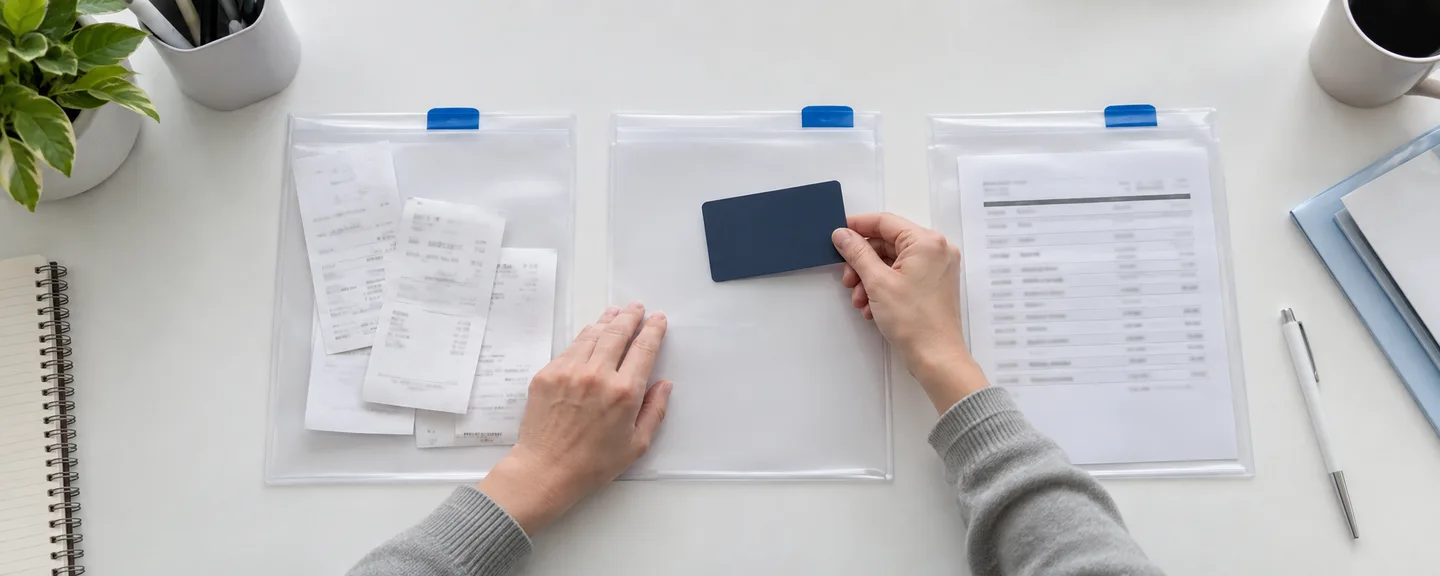
Compile the information you gathered in STEP3 and STEP4 into a table with one row per gift card.
| Item | What to enter | Main sources |
|---|---|---|
| Date obtained and source | Date purchased or received; Amazon.co.jp, store name, giver, or site name | Order history, receipts, emails |
| Card type, face value, and amount paid | E-gift, physical card, etc.; face value; amount actually paid | Order history, payment records |
| Account redeemed to and date | Which account it was redeemed to, and when | "Transactions" on the balance page |
| Orders used for and purpose | Date used, order number, items purchased, personal or business use | Balance page, order history |
Arranging everything in chronological order shows at a glance which cards came through legitimate channels and which could be a problem. Organizing the facts, including those that don't work in your favor, is the basis of a coherent explanation.
STEP6. Submit through the contact point and procedure specified in the notification
Follow the notification's instructions on where and how to submit. For buyer account holds, Help describes checking the "Your account is on hold" message, signing in, filling out a form, and attaching documents, but it doesn't say whether the same applies when gift cards are the reason. For a selling account, appeal in Seller Central as follows.
- Go to Account Health
- Click "Reactivate your account" (出品用アカウントの再開) at the top of the page
- Enter your appeal following the instructions (you may be asked to answer questions or provide supporting documents)
- Click "Submit" (送信)
Submit any additional information from "View Account Health requests" (アカウント健全性の要請を見る). Amazon gives "up to about 2 days" as a guide for responding to an appeal, but that's an estimate of when you'll hear back, not of how long reactivation will take. The overall process is summarized in the full picture from account suspension to reactivation request.
How to structure your explanation: facts, cause, actions taken, and prevention
For answering appeal questionnaires, Amazon provides guidelines such as: write factually, clearly, and concisely; focus on the facts that led to the issue; don't include information about other cases; avoid emotional language; and show the root cause and the actions you've taken, along with the dates they were implemented and related documents. These guidelines are for appealing a selling account in Seller Central, not specific to gift cards or intended for buyer accounts, but they're a useful reference when structuring your explanation. Amazon also says invoices submitted with an appeal must be unaltered originals, that editable formats won't be reviewed, and that Amazon may verify them with the issuer. The basic rule is to present the receipts and records you have as they are, without recreating them.
The framework of your explanation
- What happened: Based on your fact sheet, state the date obtained, source, account redeemed to, and orders the cards were used for
- Cause: Which aspects didn't comply with the terms, and what gap in your procedures led to it
- Actions taken: What you stopped and since when, how you'll handle unused codes, and the documents attached
- Preventing recurrence: Where you'll buy going forward, how you'll keep records, and how often and by whom checks will be done
Sample explanation (hypothetical)
The following sample assumes a case in which gift cards bought on a person-to-person marketplace site were used on a buyer account. It isn't a real case, so replace the details with your own facts and don't write anything that isn't true.
I would like to explain the circumstances of the Amazon Gift Card usage restriction on my buyer account.
Between [date] and [date], I purchased [number] gift card codes that were being sold below face value on a person-to-person marketplace site outside Amazon, redeemed them to this account, and used them to buy household goods. This source is not one permitted under the Terms and Conditions. The cause was that I had no procedure for checking whether a seller appeared on Amazon's list of authorized retailers and chose where to buy based on price alone.
Since [date], I have stopped buying from that site. I will not redeem or use the unredeemed codes, and I will not transfer or sell them to any third party. I have attached a list of the date obtained, source, amount paid, redemption date, and orders used for, along with the transaction history from my balance page.
As of [date], I have changed my practice so that I buy gift cards only on Amazon.co.jp and keep order confirmation emails in a dedicated folder. I will review my balance transactions at the end of every month.
For general guidance on writing about your improvements, see also how to structure a plan of action.
What not to do
- Creating a new account to keep buying or selling: You're allowed one selling account per region unless you have a legitimate business need and all of your accounts are in good standing. Creating a new selling account while suspended violates this rule. Amazon also says it will suspend accounts regardless of their Account Health Rating score where it suspects attempts to circumvent its systems. Don't create a new buyer account to get around restrictions either. To sort out how your accounts relate to one another, see how to sort things out when you're flagged for related accounts.
- Using leftover gift cards on a family member's account or another company account: As noted above, redeemed cards can't be used on other accounts, and transferring them after redemption is prohibited. Even with unredeemed codes, if they were obtained through an unauthorized channel, passing them to family members or another account doesn't solve the problem.
- Selling balances or codes to buyback dealers to cover your losses: This counts as resale or cashing out and can lead to account suspension or other action.
- Recreating or altering receipts or purchase records: This may be seen as deceptive and could make the situation much worse.
- Describing how you obtained cards in a way that differs from the facts: Explanations that contradict your records, such as saying cards you bought were "gifts," damage trust.
- Sending repeated inquiries without reading the notification: First check the notification's instructions and where to submit, then answer what you've been asked.
Preventing recurrence: purchasing rules, records, and scam protection
Set internal purchasing rules
Sample rules for handling gift cards
- Buy only on Amazon.co.jp or from retailers on the list
- Don't buy from resale sites, buyback sites, flea market apps, or discount ticket shops not on the list
- Don't use them to pay for inventory or for purchases intended for resale or export
- Use them on the account that received them, and don't move them to other accounts
- Don't give them as rewards for review requests or promotions
- Don't register corporate gift cards to your own company's account
If employees or contractors operate your accounts, put the rules in writing, share them, and decide who may make purchases and redeem cards on which accounts.
Keep records of purchases and use
Even if you bought your cards legitimately, without records it becomes harder to show the facts later. Save order confirmation emails and receipts, and check your balance transactions regularly. On the accounting side, transfers of gift cards and similar items are treated as tax-exempt for consumption tax purposes as "transfers of goods vouchers, etc.," and when you use them to buy products, the input tax credit is, as a rule, taken at the time you purchase the products. Check the specific treatment with your tax accountant.
Avoid getting caught up in gift card scams
Amazon's scam awareness page describes tactics such as impersonating Amazon staff or tech support to demand payment, and cheating people out of gift cards by offering to "buy your Amazon gift cards." Japan's National Police Agency also compiles and publishes figures on "support-pretext" scams, in which fraudsters obtain e-money and the like under the pretext of removing viruses from a computer, as one type of fictitious billing fraud. Gift cards obtained through scams like these may be resold to third parties. Don't use codes whose origin you can't verify, since they don't meet the source requirements of the Terms and Conditions.
The basic way to lower the risk of restrictions is to be able to show, with records, "where you bought it," "what you'll use it for," and "which account you'll use it on" every time you handle a gift card.
Frequently asked questions
Q. Is it okay to use an Amazon Gift Card I bought at a discount ticket shop?
A. The places Amazon directs you to buy from are "the Amazon site and authorized retailers." The fact that the law anticipates discount ticket shops is a separate matter from whether a source is one Amazon accepts. The safe choice is not to use cards from any seller you can't confirm on the list of authorized retailers.
Q. Can I use a gift card someone I know gave me?
A. Receiving a card as a gift is cited as an example of being an "intended recipient." A card you paid someone for is different in nature. Also, codes the giver has already redeemed to their own account can't be used. If you don't know where the giver or organizer got the card, keeping a record of how you received it (from whom, the date, and any message) makes it easier to explain if you're asked to verify.
Q. My buyer account has been restricted. Will my selling account be suspended too?
A. Whether it automatically extends to your selling account isn't officially stated. However, a selling account can also be suspended regardless of its score if fraud or deception is suspected, so check the notifications and screens for both accounts and respond to each according to its instructions.
Q. My gift card balance has been voided. Can I proceed on the assumption that it will be restored?
A. No, you can't count on it. The Terms and Conditions state that cards can be voided without a refund, and there's no published standard for whether balances are later restored. You'll need to explain the facts through the procedure described in the notification and wait for further instructions.
Q. I still have unredeemed codes that I bought on a resale site. What should I do?
A. Don't redeem or use them. Also avoid selling them to buyback dealers or giving them to others, since that counts as resale or transfer for value. Keep your records of the date obtained, source, and amount paid, and if you've received a restriction notice, explain the facts truthfully, including how you're handling the unused codes. Any refund or other dealings with the seller depend on that seller's terms.
Q. I sell on Amazon outside Japan. Can I use my Japanese gift card balance on overseas sites?
A. No. Amazon.co.jp gift cards can't be used on overseas Amazon sites such as Amazon.com or Amazon.co.uk, and balances can't be transferred to other countries' sites. Note that Amazon.com gift cards in the US have a different issuer and different terms, but like Japan, they limit where you can buy cards to Amazon and authorized sellers.

Summary
Restrictions involving Amazon Gift Cards (formerly Amazon Gift Certificates) can arise from two angles: "where you got them" and "what you used them for."
- Buy only on Amazon.co.jp or from retailers you can confirm on the list. Don't use person-to-person sales or resale sites
- Even legitimately obtained cards can't be used for sourcing inventory, cashing out, moving between accounts, or rewarding reviews
- If a violation is suspected, balances may be voided and accounts suspended. Assume your selling account could be affected, and check the notifications for both accounts
- If you're restricted, verify that the notification is genuine, organize the facts from your transactions and acquisition records, and explain them truthfully to the specified contact point
- Don't try to get around restrictions with a new account, alter records, or give explanations that differ from the facts
Even when it looks like an issue with buyer-side terms, for a seller it can affect whether the business can continue. Keep records of how you obtain and use gift cards as a matter of routine, so that when a notification arrives, you can explain the facts truthfully based on those records.
Need help with an account suspension related to gift cards?
We'll assess your prospects for reinstatement at no cost. Consultations are free, as often as you need.
 Free consultation, 24/7
*This article provides a general explanation. The appropriate response in individual cases depends on the circumstances.
Further reading
 When you cannot use your Amazon buyer account: checking the reason for a suspension or temporary suspension and preparing a support inquiry Read article →
 Reviewing order-related violations on an Amazon buyer account: order history and support inquiries Read article →
 Reviewing how you handle Amazon buyer data: responding to misuse allegations Read article →