This article is for anyone who has been invited to join a resale course through a social media ad or an info session and can't decide whether to sign up. It covers how to test the pitch against Amazon's policies, what to confirm before signing a contract, the legal options for canceling or rescinding, what to watch out for when letting an instructor operate your account, and how to think about a suspension or similar action after taking a course. The content is based on public materials, laws and regulations, and Amazon Help pages as of September 2026; Amazon's policies and screens, and how the laws are applied, may change.
What public consumer complaint data says about resale course sales pitches
Number of complaints about "resale businesses" and "business courses"
According to materials published by the National Consumer Affairs Center of Japan in February 2021, complaints about "resale businesses" rose from 548 in fiscal 2015 to 1,411 in fiscal 2019, and people in their 20s accounted for 45% in fiscal 2020 (through December 31; these figures are not specific to Amazon). In materials on "business courses" (AI courses, side-business schools and the like) published on September 16, 2026, the number of complaints and the average contract amount changed as follows (these figures are not limited to resale courses).
| Fiscal year | Complaints | Average contract amount (mail order/online sales) | Average contract amount (telemarketing sales, including solicitation via web meetings) |
|---|---|---|---|
| 2020 | 1,169 | ¥440,000 | ¥600,000 |
| 2021 | 1,831 | ¥470,000 | ¥690,000 |
| 2022 | 2,106 | ¥590,000 | ¥840,000 |
| 2023 | 2,510 | ¥570,000 | ¥880,000 |
| 2024 | 2,682 | ¥640,000 | ¥990,000 |
| 2025 | 3,551 | ¥640,000 | ¥870,000 |
Fiscal 2026 had already reached 1,121 complaints as of July 31 (compared with 821 for the same period the previous year). The average contract amount for solicitations that include web meetings has consistently been higher than for mail order/online sales, so when you're being pitched over a screen, it's important not to decide on the spot.

A typical path from pitch to contract
According to the Center's materials, the pitch may unfold as follows.
- You learn about the course as an "easy money" side business through a social media or video ad
- You're steered into adding the company as a friend on a messaging app
- You're encouraged to buy course materials costing a few thousand to tens of thousands of yen, or to attend an info session
- In a one-on-one meeting, often over a web meeting, you're pitched a support package or plan costing hundreds of thousands of yen
- To pay, you may be encouraged to use a credit installment plan or borrow from a moneylender
The 2021 materials on "resale businesses" also include a complaint about a ¥500,000 support contract described as coming with a money-back guarantee that was later deemed ineligible for a refund when the products didn't sell, and another about a "risk-free resale business" that turned out to be no-inventory reselling, which was prohibited on the flea market site involved.

Testing the pitch against Amazon's policies
It's hard to tell from the outside whether a pitch is true, so check for yourself whether the methods you'll be taught comply with the policies. Whether or not you take a course, the responsibility for following the policies lies with the seller.
| Example of what you might hear in a pitch | Rule to check it against | What to confirm |
|---|---|---|
| "You can start without any inventory" | Drop Shipping Policy | Does the method involve having another store or supplier ship directly to the buyer? |
| "Buy from flea market apps and sell as New" | Condition Guidelines | Will you be told to list items bought from individuals as "New"? |
| "We'll get you ungated so you can sell any brand" | Products requiring approval | How will the invoices used for the application be obtained? |
| "We'll introduce you to suppliers" | Invoice requirements | Can the supplier be verified? Is there any talk of creating or altering invoices? |
| "Importing is where the profit is" | Parallel import policy | Will the items be listed separately? Are they in a prohibited category? |
| "Even if you're suspended, you can start again with another account" | Seller Code of Conduct | Does the plan assume breaking the policies? |
| "There's a secret trick to getting reviews" | Prohibited seller activities | Are they encouraging manipulation of reviews or rankings? |
| "Give us your login details and we'll handle it for you" | Business Solutions Agreement | Are they asking you to share your password? |
| "Amazon-approved" | Service Provider Network disclaimer | Can they name the program that backs up the claim? |
"You can start without inventory"
Under the Drop Shipping Policy, having a product bought from a third party, such as Amazon or another seller, shipped directly from that third party to the buyer is prohibited without exception if you are not identified as the seller, or if a name other than yours appears on the packing slip, invoice or outer packaging. Violations may result in restrictions on your merchant-fulfilled listings. Even when you entrust shipping to a logistics company or similar provider, there are conditions: you must have an agreement with your supplier that makes you the sole seller of record, remove all packing slips and other materials that identify the third party, accept returns yourself, and comply with the Business Solutions Agreement and the policy. Ask who you'll be buying from and whose name the items will ship under (see also reviewing your drop shipping operations).
"Buy from flea market apps and sell as New"
Under the Condition Guidelines, products sourced from individuals (other than sole proprietors) cannot be listed as "New," even if they are unopened items from a flea market app. The same applies to products bought from a store or other business if they don't come with the same manufacturer's warranty as when bought from an authorized distributor (see also how to review New and Used conditions). In addition, under Japan's Secondhand Articles Dealer Act, goods that have been traded for the purpose of use count as "secondhand articles" even if unused, and buying and selling them as a business requires a permit from the Public Safety Commission. Check with your local police station whether you need a permit.
"We can get you ungated" and "We'll introduce you to suppliers"
Applying for approval to sell requires documents such as purchase invoices dated within the last 180 days and product photos. You can't sell products that show the message "You do not meet the requirements for this application," and you can't appeal that decision. Invoices submitted for an application must include verifiable supplier information, and Amazon may contact the supplier to confirm. Quotes, invoices you issued yourself, altered invoices, and invoices in editable formats such as .xlsx are not accepted. If anyone says "we'll prepare the invoices for you" or "we'll redo them," walk away from the contract; see also what to do when you're told an invoice was forged or altered.
"Importing is where the profit is"
Parallel imports (products imported through channels other than authorized distributors) must be listed separately from regular products on their own product detail pages clearly marked [Parallel Import], with the reason explained in the condition note. The seller is responsible for quality warranties and after-sales service, and some parallel imports are prohibited in categories such as Beauty and Watches. You also need to comply with Japanese laws such as the Electrical Appliances and Materials Safety Act.
"Amazon-approved"
Regarding the Service Provider Network, which introduces outside providers, Amazon's disclaimer clearly states that listings are for informational purposes only and that it does not endorse any service provider. If you're told a course is "approved," ask which program backs up that claim, and if the answer is vague, leave it out of your decision.

Comparing with free official resources to judge whether the cost is worth it
It's easier to judge the value of a paid course if you can put into words what it offers that free official resources don't.
| What you want to learn | Where to find it for free |
|---|---|
| Selling basics (pricing, shipping, advertising, inventory management, etc.) | Seller University (Amazon出品大学) (videos, PDFs and live webinars; Amazon says all content is free for anyone to use) |
| Details of policies and procedures | Seller Central Help and the Seller Forums |
| Dealing with warnings and suspensions | Account Health Support (アカウント健全性サポート) (a dedicated contact for Professional sellers) |
| Fees and profitability | The selling plans page (the Professional plan costs ¥4,900 per month (excluding tax) plus referral fees; the Individual plan costs ¥100 per item sold plus referral fees) |
Referral fee rates vary by category and are revised from time to time, so check the latest fee page, and if you use FBA, include those fees in your calculations too. How to prepare before reaching out is covered in getting organized before contacting Account Health Support.
Estimate whether you can recoup the course fee
The following is a hypothetical example, not a real case. For a course costing ¥600,000 in total, if your profit is ¥30,000 a month, it would take 20 months just to recoup the cost, and even longer if there are installment fees. Confirm whether the "¥X0,000 a month" figure in the pitch refers to sales or profit, and run the numbers yourself.
Profits from a side business are also taxed. According to the National Tax Agency, if you receive a salary from one employer and all of it is subject to withholding, you need to file a tax return when your income other than salary and retirement income (income, not sales) exceeds ¥200,000. Resident tax is governed by separate rules, so check with your city or town office.
Five things to have in hand before signing a contract
Based on the National Consumer Affairs Center's advice (don't judge by the ad alone, don't sign on the spot, and confirm the total amount payable and the cancellation terms), gather the following five items in writing or as saved copies of screens.
Pre-contract checklist
- (1) The business's disclosures (name, address, phone number, and the person in charge)
- (2) The total amount payable, including installment fees and add-on plans
- (3) The original text of the terms setting out refund and cancellation conditions
- (4) A list of the methods you'll be taught (sourcing, listing, approval to sell, shipping, and how your account will be handled)
- (5) The payment method and number of payments (and whether they assume you'll borrow money or pay in long-term installments)
Confirm the business's disclosures and the total amount payable
Under the Act on Specified Commercial Transactions, a business selling courses through online ads must disclose the price, when and how payment is due, matters concerning withdrawal or cancellation of an application, its name, address and phone number, and, if it is a corporation, the name of its representative or person in charge, among other things. If these aren't disclosed, ask before signing. If you apply online, save the final confirmation screen, which is required to show the price, payment timing, matters concerning withdrawal or cancellation and more, before you submit. Costs can increase step by step, so ask for the final total as a single figure.
Write down the refund and cancellation terms and the methods you'll be taught
Even with a "money-back guarantee," the conditions for it can be very detailed. In the original text of the terms, check what is and isn't eligible for a refund, how charges are settled if you cancel partway through, how and by when you must make a request, and how installment payments are handled. Also ask for the methods you'll be taught in writing, and check them against the table above.
Confirm the payment method, and don't decide on the spot
Think carefully before borrowing money or agreeing to long-term installments, and if you're told to misstate your income or the purpose of a loan on the application, don't do it. Even if you're pressured with a "today-only price," it's fine to end the conversation and talk to someone else before deciding. Send your questions in writing and keep the answers. Here is a sample inquiry.
I'm considering signing up for your course. Before entering into a contract, please answer the following in writing.
1. Your business name, address, and the name of the person in charge
2. The total amount payable, including installment fees and any additional costs
3. The conditions under which the money-back guarantee applies, and how charges are settled if I cancel partway through
4. The sourcing and shipping methods (including whether items are shipped directly from a third party to the buyer)
5. How you would handle account setup on my behalf (including whether you would ask me to share my password)
Cancellation and rescission options depend on how you signed up
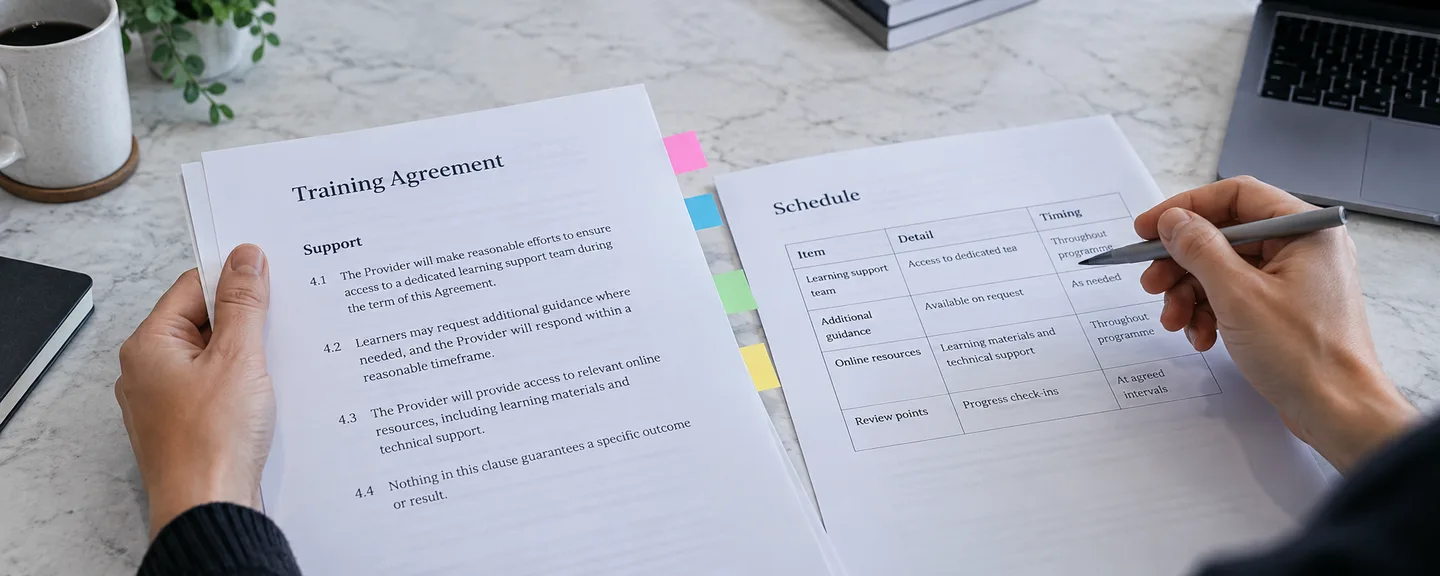
Even after signing, legal options may be available depending on how you applied and how you were solicited. However, the provisions of the Act on Specified Commercial Transactions on door-to-door sales, mail order/online sales and telemarketing sales do not apply to contracts entered into for or as a business, and the Consumer Contract Act also excludes individuals who contract for business purposes from the definition of "consumer," so contracts made to prepare for a side business are judged case by case. Treat the table as a rough guide, and consult the Consumer Hotline "188" (which connects you to your nearest consumer affairs center or similar office) or a lawyer.
| How you applied | Possibly relevant framework | Approximate time limit | Notes |
|---|---|---|---|
| You saw a web ad and applied on your own | Mail order/online sales | No cooling-off period | The statutory return rules cover sales of goods and the like, not services such as courses |
| You were solicited by phone or web meeting and then applied | Telemarketing sales (may apply) | Within 8 days of receiving the legally required documents | Whether it applies depends on how you were solicited |
| You were told "we'll provide work, so you'll earn income" | Business opportunity sales (may apply) | Within 20 days of receiving the legally required documents | The key question is whether the business itself provides or arranges the work |
| You were misled by definitive claims such as "you're guaranteed to earn" or by statements that weren't true | Rescission under the Consumer Contract Act | 1 year (3 years in some cases) from when you could ratify the contract, and 5 years (10 years in the same cases) from the contract | Records of the sales pitch are important |
| You paid by credit | Connection of defenses under the Installment Sales Act | Conditions apply | Whether or not the connection of defenses applies, if you exercise cooling-off on a credit purchase, notify both the seller and the credit company |
For telemarketing sales, the cooling-off period is counted from the day you received the application document or the contract document, whichever came first, and for business opportunity sales, from the day you received the contract document. If the documents were deficient or the business obstructed you, you may still be able to exercise it after the period ends. Give notice in writing (a postcard is fine) or by email or similar means, and keep a copy and proof of sending for at least 5 years. Note that "specified continuous services" are limited to seven types of services, such as language schools, and courses called "resale schools" are not among them, but how they're treated can depend on what they actually offer, so consult a consumer affairs center or similar office.
Before letting an instructor operate your account: how to grant access
The seller agreement states that sellers are responsible for keeping their password secure and for any actions taken using it. Help pages likewise advise that your account credentials are unique and confidential and should not be shared with anyone. When someone else needs to do work in your account, use the following mechanisms.
| Method | For | How it works |
|---|---|---|
| User Permissions (ユーザー権限) (Manage employees) | Employees and business partners | Professional sellers only. Invite users from User Permissions > Manage employees (従業員の管理). Access has no expiration until you remove it. Amazon advises limiting this to individuals you know and trust |
| Service provider authorization | Third parties outside your organization, such as consultants | Via an authorization link or through the Service Provider Network. Limited to businesses registered in the Solution Provider Portal whose roles have been approved. Access lasts 365 days and can be extended by reauthorizing. Managed under Manage Your Services (サービスの管理) |
For third parties outside your organization, such as an instructor, Help pages direct you to authorize them as a service provider. When you authorize one, limit the roles you delegate to what's necessary. If the instructor isn't registered in the portal, this method isn't available; even so, don't hand over your password, and do the work yourself. Amazon also states that the seller is responsible for the actions (including unauthorized use) of users added through User Permissions. Selling accounts cannot be transferred, so don't go along with any talk of "handing over" or "selling" an account either.
Steps to review access after you finish a course or end a contract
- Change your password and confirm that two-step verification is enabled
- In User Permissions, revoke access for any users who no longer need it
- In Manage Your Services, check the authorizations you've granted to course operators and others, and remove any you no longer need, even if they haven't expired (removal takes effect immediately)
- Check your email address, payment information, storefront and listings for any changes you don't recognize
- Removing access does not automatically cancel any outside contract, so cancel it separately

How to approach a warning or suspension after taking a course
When you receive a warning or suspension, your reference point should be Amazon's notification and Help pages, not your instructor's explanations. Under the seller agreement, if your account is suspended, you will generally be notified of the reason and your options for appeal by email or through Seller Central, except where doing so could interfere with an investigation or similar matter.
STEP1. Identify the notification and what it covers
Write down the reason given in the notification, the products or orders involved, and the actions and documents requested, and check them together with what's shown on the Account Health page.
STEP2. Compare the methods you were taught with the policies
Using the table above, determine which part of your sourcing, conditions, shipping or account management led to the reason in the notification. Even when a supplier was introduced to you, the responsibility for selling only authentic products lies with the seller and the supplier, and selling inauthentic products may result in actions such as account suspension or a hold on your disbursements (see also how to respond to an authenticity review).
STEP3. Appeal with the root cause, corrective actions and preventive measures
Appeals of a suspension are submitted from "Reactivate your selling account" (出品用アカウントの再開) at the top of the Account Health page, and Amazon says it may take up to about 2 days to get a response. The entry point for an appeal may differ depending on the action taken, such as an account suspension versus a restriction on merchant-fulfilled listings, so follow the instructions in the notification and on the page. "My instructor taught me to do it" isn't a root cause analysis, so explain, as facts about yourself (or your company), why you chose that method and which checks were missing. Below is a hypothetical sample for a case where you were cited for drop shipping without holding inventory; it is not a real case.
Following a method introduced in an outside course, I had products purchased from other online stores shipped directly from those stores to buyers. The cause was that I did not review the Drop Shipping Policy before listing, and packing slips showing the name of the store I purchased from were included in the packages.
I have deactivated all of the affected listings, and for unshipped orders, I secured the inventory in my own hands before shipping.
Going forward, I will list only inventory I have inspected myself, and before changing my sourcing or shipping methods, I will review and document the relevant policies.
How to write it is covered in how to structure a plan of action, and the steps leading up to an appeal are laid out in an overview from account suspension to a reinstatement request.
What not to do
- Continuing to sell by opening another account: Continuing to sell through another account to get around a suspension violates Amazon's policies. Under the Seller Code of Conduct, you may have only one account for each region you sell in, unless you have a legitimate business need and all of your accounts are in good standing. Having a suspended account means you don't meet that condition, and a problem with one account can lead to all of your accounts being suspended (see also sorting things out when you're told your accounts are related).
- Forging or altering invoices or other documents: Amazon requires original, unaltered documents. No matter who recommends it, forging or altering documents or submitting documents that don't reflect the facts violates Amazon's policies.
- Sharing your password with instructors or other students: The seller is responsible for any actions taken.
- Manipulating reviews or rankings: Requesting reviews in exchange for compensation and similar practices are prohibited and can lead to actions such as permanent suspension.
- Agreeing to borrow money or allow remote access: Don't borrow money to pay for a contract, and even if the business soliciting you asks, don't install a remote-control app or share your screen.
Frequently asked questions
Q. I signed a contract after being pitched in a web meeting. Can I use cooling-off?
A. It may count as telemarketing sales, but this is judged case by case based on how you were solicited, the purpose of the contract and other factors. Contact 188 as soon as possible.
Q. I was told I "don't meet the conditions for the money-back guarantee." What should I do?
A. Ask the business to state in writing which conditions you haven't met, and check that against the original text of the terms. If what you were told during the pitch differs from the terms, the rescission and other options described above may apply. Because there are time limits, keep records and contact 188 as soon as possible.
Q. Can I use invoices from a supplier introduced by the course to apply for approval to sell?
A. What an application requires is the invoice from when you yourself purchased the products. Don't use documents that don't reflect your own transactions, such as samples handed out by the course or other students' invoices. Even when you actually purchased the products, submit the documents as originals, and don't leave preparing or correcting them to the course.
Q. I was suspended for using a method I learned in a course. Can I hold the school responsible?
A. The school's liability depends on the contract terms and how you were solicited, so consult a lawyer or a consumer affairs center. In Amazon's eyes, the seller is responsible for how the account is operated, so in your appeal, show what happened in your own operations and what you have changed.
Summary
Here are the key points.
- Check each method you'll be taught, one by one, against Amazon's policies
- Before signing, get the five items on the checklist in writing
- Don't decide on the spot in a web meeting, and don't go along with requests to borrow money, make false statements, or allow remote access
- If you have concerns after signing, sort out how you applied and consult 188 or a professional
- Don't give your password to an instructor; use the proper access permissions, and review those permissions after the course ends
If you receive a warning or suspension after taking a course, use the notification and Help pages as your reference point for sorting out the cause, and respond with legitimate documents. If you're unsure, consider consulting a professional early on.
Need help? Start with a free consultation
We'll assess your prospects for reinstatement at no cost. Consultations are free, as often as you need.
 Free consultation, 24/7
*This article provides a general explanation. The appropriate response in individual cases depends on the circumstances. Start with a free consultation to discuss your case.
Further reading
 When Amazon flags product-review practices: reviewing requests and buyer communications Read article →
 When Amazon flags a forged or altered invoice: verifying facts and using genuine documents Read article →
 Responding to an Amazon authenticity review: checking evidence and appealing without an invoice Read article →