This article is for Japanese sellers who sell food, supplements, cosmetics, and similar products on Amazon.com in the United States. For products regulated by the FDA (U.S. Food and Drug Administration), it organizes what to check on which screen and which route to follow when you are flagged for a labeling deficiency or asked to submit documentation. It also covers the items to check on your English-language labels, points to watch when using the term "FDA," and how to manage deadlines.
Products Subject to FDA Requirements, and the Premise of This Article
Amazon US's Restricted Products Help covers FDA-regulated food & beverages, dietary supplements, cosmetics, drugs, and medical devices on individual pages. In every case, the premise is an English-language label that complies with US law, and depending on the product, testing or certification documents may also be required.
Listings that violate these requirements can be subject to measures such as suspension or revocation of selling privileges, destruction of Fulfillment Center (FC) inventory without reimbursement, return of inventory, or holds on payments. Leaving the issue unaddressed can also affect your account. The policies covered by the Account Health Rating (AHR) include the "Restricted Products Policy" and "Product Safety and Compliance," and repeatedly violating the same policy within 180 days can result in immediate suspension once you reach the violation limit. The more severe the violation, the fewer repetitions it may take to reach that limit, so check the specific number in your notification or in Help. For how to read the score, see how to check your Account Health Rating score.
This article is based on US Seller Central Help, publicly available FDA information, and US law as of September 2026. Policies and on-screen wording are subject to change, so please also check the latest Help content before proceeding. When you list products for buyers overseas, it is stated that the responsibility for researching compliance with the destination country's laws lies with the seller. Selling on Amazon.co.jp is governed by Japanese law and policy, but if you sell and ship to buyers in the United States, US law also comes into play.

If You Receive a Restriction Notice: Steps to Check on Screen
Notices requiring you to submit documentation or correct your labeling appear under Account Health (アカウント健全性) in Seller Central. Screen names below follow the Japanese-language display in US Help; since the actual screen wording may differ from this translation, the English term is also given.
STEP1. Check the Category of the Issue in Product Policy Compliance
Open the Product Policy Compliance (商品規約の遵守) tab under Account Health (アカウント健全性). You are directed to submit documentation from either Food and Product Safety Issues (食品と商品の安全性に関する問題) or Restricted Product Policy Violations (制限対象商品に関する規約違反の問題).
STEP2. Identify the Affected ASINs and Any Listings That Are Impacted
Note the ASIN and SKU of the affected product, then check the "Open" tab on Account Health (labeled 出品中 in the Japanese Help display) and Manage All Inventory to see whether any other listings have been deactivated. A deactivated listing remains deactivated until you submit documentation that meets the requirements and resolve any other issues affecting that ASIN.
STEP3. Record the "Next Steps" and the Response Deadline
Check what response is required in the "Next steps" (次の手順) column, and note the "Address issue by" date (対応期限) shown in the notification. The number of days allowed until the deadline differs by notification. Because products may also be subject to periodic testing or random surveillance testing, you may receive a new notification even for a product you have previously submitted documentation for.
Identifying the Right Response Route: Via a TIC, Direct Submission, or an Appeal
Your response generally falls into one of three routes. Submitting to the wrong destination can waste the limited time you have before the deadline, so decide on the route first. A TIC is a third-party testing, inspection, and certification service accredited by Amazon.
| Route | Main products covered |
|---|---|
| Via a TIC | Dietary supplements, ingestible OTC drugs, skin-lightening cosmetics, edible metal leaf, and similar products |
| Directly to Amazon | Cosmetics label images requested by Amazon, infant formula, baby food, and similar products |
| Appeal | When documentation is not required, or you believe the violation was determined in error |
The TIC Route
- You can only submit a Test Request Form (TRF) after receiving a documentation-request notification, and it must be submitted to your TIC provider by the response deadline. Once you send a sample or existing documentation, the provider submits the documentation to Amazon on your behalf.
- While the TIC provider has received your TRF and its status is "in progress," your listing is stated not to be deactivated. However, if the testing or document review results in a fail, the listing is deactivated immediately.
- The list of accredited providers is updated monthly, so check the latest version under "Select a Provider."
For dietary supplements and ingestible OTC drugs, Help also directs you, alongside TIC verification, to submit a Certificate of Insurance (COI) through "Business Insurance Verification" (事業保険の確認) in Seller Central. Check the conditions that trigger the insurance requirement (the sales threshold and the change planned from November) in the table and FAQ later in this article. cGMP (Current Good Manufacturing Practice) certification requires an accredited third-party audit and certification; self-audits and FDA inspections are not accepted, so confirm this with your manufacturer before sourcing.
The Route for Submitting Directly to Amazon
- Open the list of relevant issues on the screen from STEP1
- In the "Next steps" column, select "Submit" for the affected product
- Select "Add compliance information for this product" (if you have multiple products, bulk upload is also available)
- Upload the file, click "Submit," and record the date/time, file name, and ASIN
Common Rules for Documents and Images
- Genuine and in their original, unedited format (documents or images generated by computer or AI are not accepted)
- Not issued by a testing lab that is currently suspended
- Labels, warnings, and instructions are written in the language of the destination country
- Images showing that the tested item is identical to the listed product, plus images of all sides
- For bundled/set products, documentation and images are provided for each component item
The Appeal Route
From the same screen, select "Appeal requirement" (申し立ての要件), choose a reason, and enter an explanation. In your explanation, briefly state the affected ASIN, why you believe the requirement does not apply (the product's classification or intended use), the parts of the label and product page you reviewed, and any documents you attached. Note, however, that Amazon may classify a product as a dietary supplement if it carries dosage instructions (such as "take 2 capsules per day") or structure/function claims (such as "supports immune function"), so review your product label and product page before filing an appeal. If the labeling or page has a deficiency, the standard approach is to correct it and submit documentation.
For restricted-product warnings in general, see how to respond to restricted-product warnings; for the approach to supporting documentation, see checking product-safety warnings and supporting documents.
Checking Your English Label Item by Item
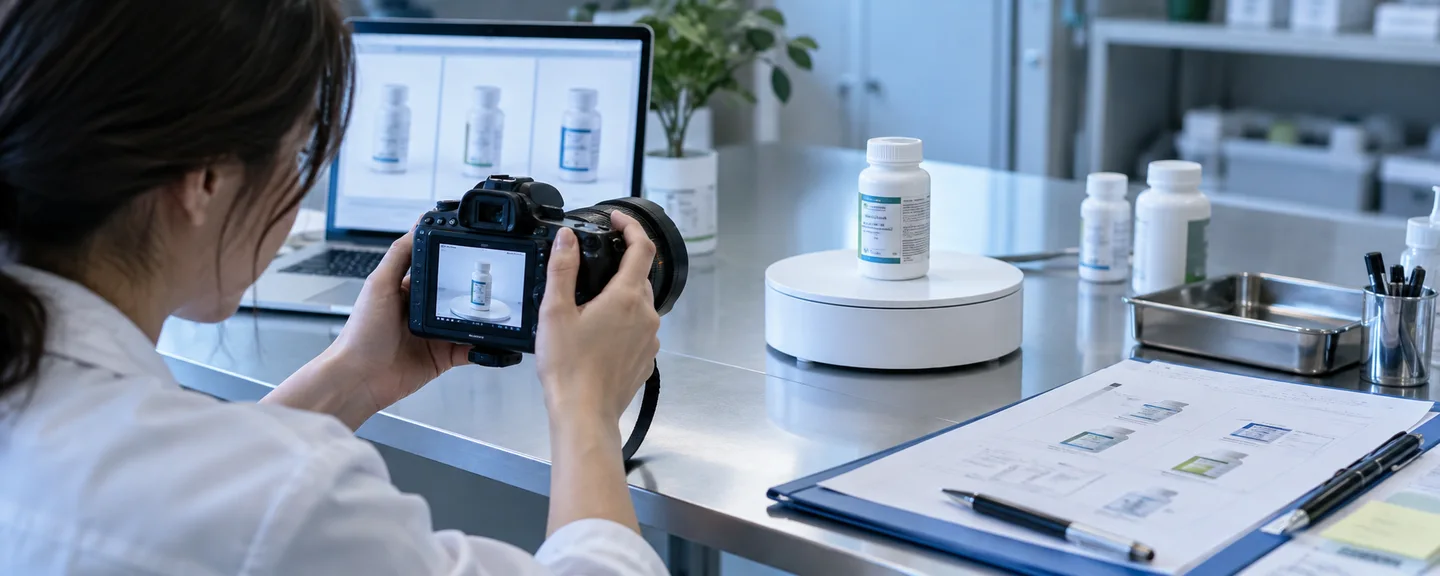
Amazon requires images of all sides of the product and its packaging. After photographing every side, checking whether the following items appear in the images helps reduce the chance of missing something.
| What to check | Key points to confirm |
|---|---|
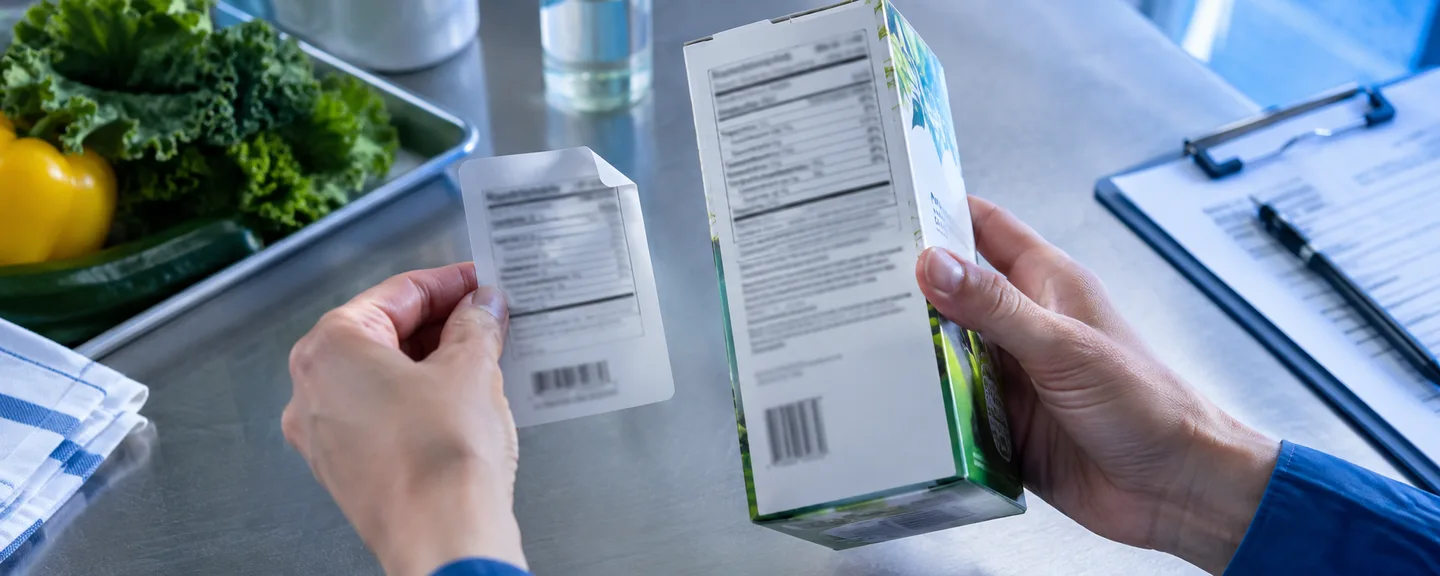
| Front (Principal Display Panel) | English product name, product identity statement, and net quantity. As a rule, net quantity is stated in both US units (pounds, ounces, etc.) and metric units (g, mL, etc.). For food, dietary supplements and cosmetics alike, check how to state it against the latest FDA guidance and Amazon Help |
| Manufacturer/Distributor | Name and address. If you are not the manufacturer, use a qualifying phrase such as "Manufactured for" or "Distributed by" |
| Ingredients | For food, listed in descending order by weight. For cosmetics, also in descending order (ingredients at 1% or less and colorants are exceptions) |
| Nutrition panel | Nutrition Facts for food, Supplement Facts for dietary supplements. If the panel continues on another side, photograph that continuation too |
| Allergens | For food and dietary supplements, the nine major allergens (milk, eggs, fish, crustacean shellfish, tree nuts, peanuts, wheat, soybeans, sesame) must be shown either in parentheses after the ingredient (e.g., flour (wheat)) or in a "Contains" statement. Tree nuts, fish, and crustacean shellfish must be identified by specific type (e.g., almond, cod, shrimp) |
| Country of origin / warnings | Imported products must show the country of origin in English (e.g., "Made in Japan"). Images of food products must show the accurate country of origin. For cosmetics, also check for warning statements and fragrance-allergen disclosures |
| Contact information | For cosmetics, at least one of the following where adverse events can be reported: a US address, a US phone number, or an electronic contact (such as a website). This has been required since December 29, 2024 under MoCRA (the Modernization of Cosmetics Regulation Act of 2022), and a Japanese address and phone number alone may not satisfy it |
| Identification code / dates | Lot number, serial number, matrix code, and similar identifiers. For FBA, products that are ingested require a best-by/expiration date or manufacture date; a lot number alone is not sufficient |
Additional Checks by Category
- Food & Beverage: Must be brand new, sealed in its original packaging, and have a remaining shelf life of more than 90 days (refrigerated, frozen, and fresh products are subject to a separate policy). Selling individual items taken from a labeled case is not allowed, and any organic claim requires USDA certification and the name of the certifying body.
- Dietary Supplements: Labels such as "sample," "not for sale," or "not for resale," and disease names in search keywords, are not allowed. Products such as those for muscle building or weight management also require NSF/ANSI 173-2024 testing (or equivalent).
- Cosmetics: Cosmetics sold in the US store must comply with US law, even if it is a country-specific version intended for another store. If the product also qualifies as a drug, check the Drug Facts panel as well.
- OTC Drugs: A Drug Facts panel is required, along with an NDC (National Drug Code) permanently marked on both the product and its outer packaging.
- Medical Devices: The premise is listing in the FDA's registration and listing database, and the label must include the device name, model name, UDI (Unique Device Identifier), and similar information. Devices requiring a prescription cannot be shipped through FBA.
Examples of dietary supplements that cannot be sold even after correcting the labeling include those containing CBD, controlled substances, or unapproved drug ingredients, transdermal patches, and pure powdered caffeine.
Reviewing How You Use "FDA" and Efficacy Claims
Unless it has a written authorization or license agreement, the FDA does not allow private businesses to use its logo in materials or advertising, and Amazon's food, dietary supplement, and medical device pages likewise state that the logo may not be used. Products marketed as "FDA Cleared" or "FDA approved" are also subject to additional requirements on Amazon.
| Wording | What you should know about it |
|---|---|
| "FDA approved" | The FDA does not approve cosmetics or dietary supplements. For drugs, this term applies only to products approved under an NDA/ANDA, and cannot be used for OTC monograph drugs |
| "FDA cleared" | A 510(k) for a Class II medical device is a "clearance," which is different from "approval." This term cannot be used for a device without a 510(k), and even where a device has one, using this wording subjects the listing to Amazon's additional requirements |
| "FDA registered" | The FDA states that registration or listing does not mean approval. Because it risks being mistaken for approval, it's safest not to use this wording. For medical devices, labeling that creates the impression of official approval based on registration can be considered misleading |
| "FDA certificate" | As of September 9, 2026, the FDA has announced that it does not issue certificates or confirmation documents for cosmetic facility registration or product listing. If you receive one from a business partner, verify who issued it and what it says |
Claims of Treating or Preventing Disease
The US "Misleading or prohibited language" policy applies to product detail pages in every category, including images, descriptions, packaging, and promotional materials, and prohibits claims that a product diagnoses, treats, or prevents disease without FDA approval. For cosmetics, Help gives the example that "reduces the appearance of wrinkles" is acceptable, while "eliminates wrinkles" is not.
If you make a structure/function claim for a dietary supplement (for example, "helps support healthy bones"), state the following disclaimer in bold, placed adjacent to the claim or linked to it with an asterisk or similar mark (if it is not adjacent, enclose it in a box). If there are multiple claims, begin with "These statements have not been evaluated..." In addition, the manufacturer, packer, or distributor must notify the FDA within 30 days of starting to sell the product bearing that claim.
This statement has not been evaluated by the Food and Drug Administration. This product is not intended to diagnose, treat, cure, or prevent any disease.
Example: Revising the Wording
The following is an example that illustrates the approach; it is a hypothetical example, not an actual case (in practice, this would be written in English).
Before: A moisturizing cream made in an FDA-approved factory. It cures skin irritation from dryness and eliminates wrinkles.
After: A cream formulated with moisturizing ingredients. It hydrates the skin and reduces the appearance of wrinkles.
After (as it would appear in an English listing): Moisturizing cream that hydrates the skin and reduces the appearance of wrinkles.
This removes the reference to the FDA and turns the absolute claim into a statement about visible change. This reflects the approach shown in Amazon US's Help examples. Japan's Pharmaceutical and Medical Device Act and the standards for cosmetics advertising claims are different, so don't reuse this wording as-is in your Amazon.co.jp listings. Have the final wording confirmed by a specialist, and for how to revise your language, see responding to inaccurate or inappropriate content warnings as well.
Before You List a Japan-Spec Package As-Is
Leaving the labeling as it is for the Japanese market can create the following kinds of gaps or inconsistencies.
- Leaving part of the label in Japanese: Food Help requires that all mandatory statements be written in English. In addition, the labeling regulation (21 CFR 101.15(c)) requires that, if a foreign-language statement is also present, all mandatory statements must also appear in that foreign language — so if you keep some Japanese text, make sure the Japanese side also includes all the required items.
- Adding an English sticker on top: Amazon's medical device policy prohibits placing a label over another label. For FBA, it is recommended not to cover the original best-by date, ingredient statement, or distributor information, so whether an added sticker is sufficient needs to be checked product by product.
- Inventory already at an FC: Even after you correct the labeling, check whether inventory already at an FC still carries the old label. Decide whether to have it returned and relabeled or take some other action based on the guidance in your notification and Help (note that medical devices cannot have a label placed over another label).
- Reusing your Japanese listing content and images: Amazon's image requirements call for images that show the complete English label as it is actually affixed to the product. Check whether your images still show the Japanese-language label.
- Number of allergens: Sesame was added to the major allergens list effective January 1, 2023. If you are still working from older Japanese materials based on the former eight US major allergens, sesame will be missing (note that the US list differs from Japan's specified allergenic ingredients).
- Food facility registration and import procedures: Facilities that manufacture, process, pack, or hold food consumed in the United States generally must register with the FDA, whether located domestically or abroad (certain exceptions from registration are defined, such as for foreign facilities whose food undergoes further manufacturing or processing at another foreign facility before export, or farms). Foreign facilities must also designate a U.S. Agent. Imported food requires Prior Notice submitted by a specified time before arrival.
For the importer's obligations (such as the Foreign Supplier Verification Program, or FSVP), check with your customs broker or a US specialist. For how to proceed if you end up suspended in the US store, see reinstating overseas Amazon accounts.
Managing Deadlines and Dates in One Place
Amazon's notifications, FDA procedures, and insurance deadlines all move forward in parallel, so it helps to keep them together on a single sheet.
| Item | Deadline / Date | Notes |
|---|---|---|
| Notification response deadline | Varies by notification | For products going through a TIC, submit your TRF by this date |
| Remaining shelf life on arrival at an FC | Time until fully consumed, plus 90 days | Example: a 240-day supply of a supplement needs 330 days. Products already expired on arrival are subject to disposal and cannot be returned |
| Structure/function claim notification | Within 30 days of starting to sell the product with the claim | Dietary supplements. The disclaimer statement is also required |
| Food facility registration renewal | October 1 – December 31, 2026 | The renewal window is October–December of even-numbered years. Registration and renewal are free |
| Expanded insurance requirement | Planned to take effect November 2, 2026 | Dietary supplements and similar products may already be asked to submit a COI, and from November 2 onward, insurance with $1 million in coverage is planned to be required regardless of sales volume |
Responses You Should Not Take
- Relisting the same product under a new account: Using a separate account to avoid a restriction or suspension is a policy violation and makes the problem worse.
- Editing test reports or label images, or generating them with AI: Documents that are not in their original, unedited format are not accepted, and if tampering is suspected, the authenticity of the documentation itself is called into question — a problem that can grow beyond something a simple labeling correction can fix. Even if you're unsure how to respond, the basic approach is to gather legitimate documentation rather than resorting to editing or fabrication.
- Fixing only the description text and leaving the images unchanged: Because the prohibited-language policy also covers images and packaging, the issue is not resolved if things like the FDA logo remain in your images.
Frequently Asked Questions
Q. Do I need insurance even if my monthly sales don't reach $10,000?
A. Currently, you are required to obtain coverage within 30 days if your total monthly sales on Amazon.com exceed $10,000 US, or if Amazon requests it, among other triggers. From November 2, 2026, sellers of dietary supplements, ingestible OTC drugs, ophthalmic drugs, and similar products are planned to need insurance with $1 million in coverage regardless of sales volume. Check Help for the latest details.
Q. Does a small cosmetics brand also need to complete MoCRA facility registration and product listing?
A. MoCRA requires FDA registration of manufacturing/processing facilities (renewed every two years) and product listing by the responsible person named on the label. Small businesses — generally those with average annual US cosmetics sales under $1 million over the past three years — may be exempt, but products that contact the mucous membranes of the eye are not excluded. The requirement to include US contact information on the label applies separately. Check with a specialist to see whether this applies to you.
Q. My test report has an item marked "non-conforming." Can I submit it as is?
A. Only results of "Pass" or "Not Applicable (NA)" are treated as valid; "Fail," "Non-conforming," "Not met," or blank entries are not accepted. Check the cause with your manufacturer, and consider making improvements and retesting.
Q. It doesn't look like I'll have my documentation ready by the notification deadline.
A. For products going through a TIC, the priority is to submit your TRF by the deadline. For products submitted directly, organize where you can obtain the missing documentation and your timeline for getting it, and follow the guidance shown on screen.
Summary
- Check notifications under Account Health (アカウント健全性) → Product Policy Compliance (商品規約の遵守), and record the affected ASIN, the next steps, and the response deadline
- First identify which route applies: via a TIC, directly to Amazon, or an appeal
- Photograph and check all sides of the label, confirming the mandatory English statements, the nine major allergens (for food and dietary supplements), US contact information (for cosmetics), country of origin, and identification codes
- Don't use the FDA logo, unsupported claims of "FDA approval," or wording that claims to treat or prevent disease
- Manage notification deadlines, FBA remaining shelf-life requirements, facility registration renewals, and insurance requirements in one list
Also check whether other sizes or series of products that share the same label have the same labeling issue, and consult a specialist familiar with US regulations on any points you're unsure about.
Need help with FDA labeling requirements?
If an FDA labeling-related warning, a listing restriction or an account suspension is involved, we can help you sort out your situation at no cost, including your prospects for reinstatement. Consultations are free, as often as you need.
 Free consultation, 24/7
*This article provides a general explanation. The appropriate response in individual cases depends on the circumstances.
Further reading
 Reviewing your Amazon Account Health Rating: warnings and improvement priorities Read article →
 From Amazon account suspension to an appeal: reviewing the notice and planning your response Read article →
 Amazon product safety warnings: identifying products and checking supporting documents Read article →