This article is for sellers who are trying to write a plan of action from a template or from sample wording passed along by someone else, or whose plan of action written that way was not accepted. We lay out the parts a template can't fill in, how to replace generic wording with your own business's facts, how requirements differ by type of violation, and how to revise your submission after a rejection.
What a template-based plan of action is missing
In most cases, what a template-based plan of action is missing are the facts that only you, the seller, can supply: the affected ASINs, the number of cases, the dates changes were implemented, and the documents that back them up. In Japanese Help, the plan of action is called a "performance improvement plan (POA)" (パフォーマンス改善計画), and it forms part of the content of the appeal (申し立て) you submit from the Account Health (アカウント健全性) page. This article is based on Seller Central Help, the Amazon Services Business Solutions Agreement, and Amazon Seller University materials that we were able to review as of September 2026, and in some places it also refers to comments by Amazon staff on the US Seller Forums. Policies and screens can change, so please also check the latest Help content.
The level of specificity Amazon expects in an appeal
The Help page "Respond to an appeal questionnaire to reinstate selling privileges" (出品権限を回復するために申し立ての質問書に回答する) sets out writing standards that can be summarized roughly as follows.
- Write clearly and concisely, based on facts. Focus on the facts and events that led to the issue, not on introducing your products, your company, or your customers
- Do not include information about other cases, and do not use emotional language
- Identify the root cause, even if there are multiple issues (for example, suppliers that can't be verified, or problems with inventory management or quality control)
- Show the actions you have taken, along with specific details, the dates the changes were implemented, and relevant documents
- Provide evidence for every product and ASIN under review
With a template designed to fit anyone, the dates changes were implemented, the relevant documents, and the evidence for each ASIN tend to be left blank or filled with plausible-sounding generalities.
| What Amazon asks for | What tends to happen with a template | What you need to prepare |
|---|---|---|
| The facts that led to the issue | Opens with a company introduction or a pledge to put "customers first" | The period in question, the affected ASINs, what happened, and the number of cases |
| Root cause | A one-liner that could apply to anyone, such as "our management was inadequate" | Which check, in which step of your process, was missed |
| Actions taken | Ends with "we reviewed" or "we made sure to enforce" | What was changed, the date the change was implemented, and documents or records that show it |
"Detailed" doesn't mean "long"
On the US Seller Forums, an Amazon staff member commented to a seller whose appeal of an intellectual property suspension had not been accepted that asking for detail is not about adding more words, and that there is no one-size-fits-all appeal because every seller's inventory, suppliers, products, and fulfillment methods are different (this comment dates from around 2021 and is not an official review standard). We have also not been able to find any official character limit or recommended length, or any official statement that Amazon automatically detects and rejects templates.
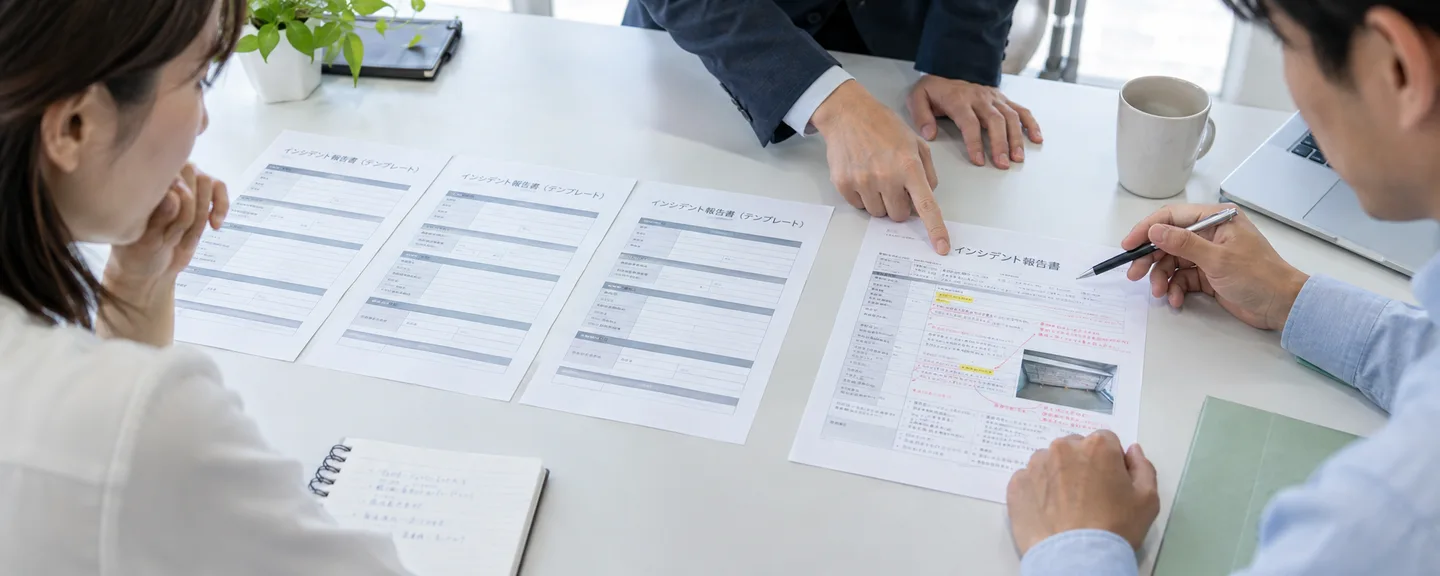
Before you start writing: list the points you need to answer from the notification
A plan of action exists to answer the reasons stated in the notification. Section 3 of the Business Solutions Agreement states that, in the case of a suspension or termination, Amazon will in principle notify you of the reason and of options to appeal (there are exceptions). Start by writing down the points raised in the notification.
Items to copy down from the notification
- The policy name or description of the issue given as the reason
- The list of affected products (Amazon says it appears at the bottom of the initial notification)
- The submission deadline (this varies by notification)
- The documents requested and the period they must cover (some products require invoices covering the past 365 days)
The format of your appeal is determined by the questions on screen
You create an appeal of an account suspension from "Reactivate your selling account" (出品用アカウントの再開) at the top of the Account Health page (per the steps in Help). What you're asked for isn't always a free-form plan of action; it may instead be a questionnaire, an acknowledgment of the violation, answers to questions, or supporting documents. Product-level violations are handled one violation at a time, following the "Next steps" (次の手順) guidance for each product. Prepare your answers to fit the questions on screen, not the shape of a template. The overall process is laid out in the full picture, from account suspension to requesting reinstatement.
What you submit depends on the type of violation
Most templates follow a "cause, corrective action, prevention" format written in prose, but depending on the type of violation, the core of your submission may instead be documents, a retraction of the complaint by the rights owner, or answers chosen from a set of options. We organized the table below based on the descriptions in Japanese Help.
| Type of violation | Core of the submission | Common mismatch when reusing a template |
|---|---|---|
| Cancellation Rate / Late Shipment Rate (seller-fulfilled) | Eligible sellers may be shown a five-question quiz. After a suspension, a plan of action | Ends with "we will review our shipping operations" without identifying the type of cause |
| Authenticity / quality | Invoices that meet the requirements | Invoice dates or quantities don't meet the requirements |
| Intellectual property rights | A reply to the notice, a request to the rights owner to retract the complaint, invoices showing authenticity, written authorization, and so on | Sending a plan of action that assumes a violation without first confirming which path applies |
| Product condition | Choosing from the options provided and submitting evidence | Pasting in a plan of action, which won't be accepted |
| Prohibited products and similar | A plan of action that identifies at which stage of inventory handling or sourcing the item got mixed in, plus records showing that inventory was checked | Doesn't mention suppliers or how inventory is checked |
| Suspected fraud or misrepresentation, violations of policies not covered by the Account Health Rating (AHR), and similar | The explanation and materials requested in the notification | Reusing the format of a metrics-based plan of action |
The last row covers the category Amazon describes as possibly leading to suspension regardless of your AHR score. For suspensions of a fundamentally different nature, the same kind of write-up simply doesn't fit.
Key points for metrics, intellectual property rights, and product condition
- Cancellation Rate / Late Shipment Rate: The Cancellation Rate Help page states that if you answer the quiz within 72 hours and pass, no plan of action is required (both quizzes are shown only to eligible sellers, and the Late Shipment Rate page makes no mention of a 72-hour deadline). After a suspension, identify which type of cause each order falls under. For Late Shipment Rate, "Performance issue 2" (パフォーマンスの問題2) lists causes such as a surge in orders, forgetting to turn on extended holiday settings, and weather such as typhoons. For Cancellation Rate, "Performance issue 3" (パフォーマンスの問題3) lists causes such as sharing inventory with other sales channels, supplier stockouts, and forgetting to change listing status before a holiday.
- Intellectual property rights: Help lays out different responses for each situation: a warning on a product you have never listed, cases where you have a business relationship with the rights owner, listings removed in error, disputing multiple warnings for products you're confident are genuine, and account suspensions. Help states that you can be subject to enforcement even if you infringed unknowingly, so "we didn't know" alone does not explain the root cause. For details, see our overview of intellectual property warnings.
- Product condition: The format asks you to choose whether you recognized and corrected the violation or whether the violation was flagged in error and you have evidence, and Amazon states that performance improvement plans are not accepted. If you think FBA inventory is the cause, first request a bin check (a check of the condition of your FBA inventory) and include the resolved case ID.
If the determination itself is wrong, your approach changes. Help distinguishes a dispute (異議申し立て), which presents evidence that the violation was detected in error, from an appeal, which is for cases where a violation did occur but was unintentional and should be reversed. If there was no violation but you send a "cause and prevention" write-up that assumes one, your argument points in the wrong direction.

Build a fact inventory table before you write
Create one row per ASIN or per issue, and fill in four columns: "What happened (content of the notification, affected ASINs, period, number of cases)," "Why it happened (which check, in which step of the process, was missed)," "What you did (details of the corrective action and the date the change was implemented)," and "How you can show it (invoices, reports, images, case IDs, checklists)."
Any row with the fourth column blank isn't ready to go into an appeal yet. If you're going to write "we addressed it," gather the documents or records that prove it first.
Where to find the facts
| Facts you need | Where to check | Notes |
|---|---|---|
| Reason, affected items, deadline | Performance Notifications (パフォーマンス通知) and notification emails | Deadlines vary by notification |
| Violations for each product | "View all" (すべて表示) in Product Policy Compliance (商品規約の遵守) → "Next steps" | If nothing is shown, also check suppressed listings under Manage Inventory (在庫管理) |
| Orders that shipped late | Account Health → "View details" (詳細を表示) under Shipping Performance (出荷パフォーマンス) → "Late Shipment Rate" (出荷遅延率) tab → "Download report" (レポートをダウンロードする) | Dates and times are shown in UTC (Coordinated Universal Time). Add 9 hours to UTC to get Japan time |
| What buyers were unhappy about | The Voice of the Customer (購入者からの評価) page | Used to identify the cause of condition violations |
| Proof of sourcing | Supplier invoices | An issue date within 365 days before you received the notification, quantities covering the sales volume and inventory of the affected ASINs, the supplier's contact information, and so on |

What to watch out for when attaching documents
Help advises that highlighting the important parts of your materials (such as ASINs, supplier names, and the supplier clauses in your terms of trade), for example by circling them, makes them easier to understand. The Help page on invoice requirements allows you to remove pricing information and to highlight the products covered by the appeal. On the other hand, invoices must be original and unaltered; invoices that have been tampered with, are in an editable format, or were issued by the seller themselves are not accepted, and Amazon may verify them directly with the supplier or rights owner. Don't change any of the content, such as numbers, dates, or names, and keep the original documents as well. If the authenticity of your invoices is questioned, also see what to do when you're told your invoices were forged or altered.
Sort the sentences in your template into three groups
Once your fact inventory table is ready, go through your template or draft one sentence at a time and sort each into the three groups below. Take the dates, numbers of cases, and documents you need to fill in group 1 from your fact inventory table.
| Group | How to tell | What to do |
|---|---|---|
| 1. Sentences that work once filled in with facts | There is room to insert dates, ASINs, numbers of cases, supplier names, or the names of settings you changed | Fill them in with actual numbers, names, and dates. If you can't, treat them as group 2 or 3 |
| 2. Sentences that are only abstract promises | Sentences ending in "we will ensure," "we will review," or "we will strengthen," and explanations that stop at "we didn't know" or "there was no ill intent" | Rewrite them to state who will check what, starting when, how often, and where it will be recorded. Rewrite "we didn't know" as why you were unable to verify it (which check, in which step, was missed) |
| 3. Sentences that don't apply to your business | Sentences that don't match the facts, such as measures you haven't implemented or departments and rules that don't exist | Delete them |
The reason you must not leave group 3 sentences in place lies in Amazon's terms. In Section 5 of the Business Solutions Agreement, each party represents that the information it provides to the other party is at all times accurate and complete. The Seller Code of Conduct also sets out as a principle that you must not engage in misleading conduct, and it explicitly states that this covers communications between sellers and Amazon.
Rewriting examples (hypothetical examples, not actual cases)
The parts in parentheses are where you fill in your own business's facts.
| Template wording | Rewritten with your own facts |
|---|---|
| Since our founding, we have always put customer satisfaction first. | Delete it and start with the facts: "During (period in question), we sent shipping confirmations after the expected ship date for (number) seller-fulfilled orders." |
| Going forward, we will source only from reliable suppliers. | Before we begin trading with any new supplier, (job title of the person responsible) confirms the supplier's business information and contact details and whether they can issue invoices showing where the inventory came from, and records the results in (storage location). We have done this since (date the change was implemented). |
| We lacked knowledge of intellectual property rights. | We had no procedure for checking, before listing, whether product names, logos, or images contained another company's trademarks. Since (date the change was implemented), we have recorded the check date and the person responsible in our listing management sheet. |
A rewritten sentence includes a date, a person responsible, and where records are kept. If you can't write these in, that's a sign that your actions or your fact-checking are not yet sufficient.
Assembling the body: cause, actions, and prevention
Amazon Seller University materials (English-language materials aimed at global selling, separate from Japanese Help) explain that a plan of action usually consists of three parts: the root cause, the actions taken to resolve the issue, and the solutions to prevent it from happening again. The Japanese Help page explaining how to write an appeal (the questionnaire Help page mentioned at the start) explicitly calls for identifying the root cause and showing the actions taken, with specific details, the dates the changes were implemented, and relevant documents. In addition, the Japanese Help page on restricted products states that sellers who effectively address the root cause of a violation and prevent it from recurring may be allowed to have their accounts reinstated. Build your plan around these three elements, and if there are questions on screen, follow their order and format. How to write each element is covered in how to structure a plan of action.
Sample text: Late Shipment Rate (hypothetical example, not an actual case)
This is a skeleton sample for when your listings have been suspended because of your Late Shipment Rate. Fill in the parts in parentheses with your own facts.
[Root cause] After reviewing the Late Shipment Rate report for (period in question), we found that of the (number) late orders, (number) were orders received during (closure period) and the remaining (number) were due to (other cause). The orders during the closure period were late because we had no set procedure for changing listing status or adjusting handling time before a closure (the methods described in the Help page "Vacation settings" (休暇の設定)). The orders due to (other cause) were late because (missing check) was not carried out in (process name).
[Actions taken] On (date), we shipped all unshipped orders and sent shipping confirmations. On (date the change was implemented), we added a task to the shipping staff's checklist to confirm that listing status has been changed or handling time adjusted at least (number) days before a closure begins. If convenience store payment is enabled, we also confirm that it was disabled 7 days before the vacation begins (attached: updated checklist). For the orders due to (other cause), on (date the change was implemented) we implemented (corrective action).
[Prevention] The shipping lead (job title) checks the Late Shipment Rate every (day of the week) and records the figures and actions taken in a log.
If there are multiple causes, provide a breakdown showing which cause each late order falls under. How to carry out the cause analysis is covered in ways to improve your Late Shipment Rate.
Write your prevention measures as operations, not as an essay
For policy violations covered by the AHR (such as intellectual property rights, product condition, and restricted products; you can check which ones are covered in the Help page "Policies included in the Account Health Rating" (アカウント健全性の評価に含まれるポリシー)), even a violation that has been removed from the list through an appeal may still be counted toward repeat violations for 180 days if you did not dispute that the violation occurred. Starting July 23, 2025, deductions grow larger each time you repeat a violation of the same policy, and if you reach the limit within 180 days (possibly two violations for high-severity violations), your account may be suspended immediately. Metrics such as Late Shipment Rate are not on this list, but if you continue to fall short of the targets, your listings may be suspended again.
Prevention measures are not a piece of writing for the review; they are the actual operations you will continue after you submit. The elements to include are the same as those listed for group 2 of the sorting step: who will check what, starting when, how often, and where it will be recorded. Day-to-day management after reinstatement is covered in reviewing your operations after reinstatement.
If you get a rejection or a request for more information: revise based on what's changed since last time
Submit additional information from "View Account Health requests" (アカウント健全性の要請を見る, as labeled in Help), and if an invoice is rejected, check the reason in Performance Notifications. For how to respond to each type of email, see how to tell review emails apart.
Switching to a different template or making your text longer doesn't count as responding to the issues raised. Track the differences from your previous submission in three columns (hypothetical example, not an actual case).
| What you submitted last time | Issue raised this time | Facts and evidence to add |
|---|---|---|
| Stated that "we reviewed our suppliers" | Insufficient explanation of the root cause | Which supplier, and which check was missing. The date the change was implemented and records of the checks |
| Submitted invoices | Do not meet the requirements | Confirm the reason, and make a legitimate request to the supplier for an original that meets the requirements |
| Explained only some of the affected ASINs | Additional information needed | Evidence for the missing ASINs, checked against the product list in the notification |
| Described measures that had not been implemented | (Wording from the notification) | A correction of the previous statement, plus the actual implementation date and records |
If your previous appeal included measures you hadn't implemented or statements that didn't match the facts (such as template sentences left in as-is), clearly point this out and correct it in your new appeal. Here is sample wording for a correction.
In our previous appeal, we stated that "(what was stated)," but this had not been implemented at the time of submission. On (date the change was implemented), we began (what was implemented), as shown in (attached documents).
If you simply add new content without correcting the earlier statement, the conflict between your previous and current explanations will remain on record. When you resubmit or make an inquiry, also keep the following points in mind.
- Don't repeatedly send the same documents or inaccurate documents before enough time has passed for the review (the Help page for identity verification reviews includes a note on this)
- Open only one contact with Technical Support per issue, and don't create a new case if one is already under review
- We have not been able to find any official rules on the number of appeals or the interval between resubmissions. When you resubmit, do so only once you can show the differences from last time (the facts and evidence you added) in the table above
A checklist to use before submitting your plan of action is helpful for a final check before you send.
What not to do
- Copying in measures you haven't implemented or systems that don't exist: This means providing information that doesn't match the facts.
- "Tidying up" documents by rewriting their content or creating them yourself in place of the supplier: Tampered invoices and invoices issued by the seller are not accepted, and providing Amazon with information that doesn't match the facts violates Amazon's terms. For documents you don't have on hand, ask the supplier to legitimately reissue them.
- Creating a new account while your account is suspended or under review: Under the Seller Code of Conduct, you may maintain only one account per region in which you sell, unless you have a legitimate business need and all of your accounts are in good standing. A suspended account can't be considered "in good standing." Attempts to circumvent Amazon's systems are described as possible grounds for suspension regardless of your AHR score, and Amazon staff on the US forums have also warned that this can lead to permanent suspension.
Frequently asked questions
Q. Is it okay to use a template from the internet as a reference?
A. It can be useful as a reference for structure, but rewrite the text using your own business's facts and delete any sentences that don't apply. A template can't fill in the dates changes were implemented or the relevant documents.
Q. Is it okay to write a draft with generative AI?
A. We haven't found any official position from Amazon on this. Whatever method you use to draft, it's the seller's responsibility to confirm that the content matches the business's facts and can be backed up with documents. Check it using the three-group sort.
Q. Do I have to include prevention measures?
A. The Japanese Help page explaining how to write an appeal explicitly calls for the root cause and the actions taken. However, the Japanese Help page on restricted products also states that sellers who address the root cause and prevent recurrence may be allowed to have their accounts reinstated, so as a rule, you should build your plan to include prevention measures as well. Note that some formats, such as those for product condition violations, don't accept a plan of action, so follow the instructions on screen.
Q. My submissions keep getting rejected no matter how many times I send them.
A. Confirm the issues raised in the notification, and organize the differences from your previous submission. Clearly point out and correct any inaccurate statements from last time. If you believe the determination itself is wrong, consider taking the dispute route and submitting evidence.
Summary
A template can help you understand what a plan of action looks like, but the content Amazon is looking for can only come from your own business's facts.
- Decide what to submit first, based on the reason, affected ASINs, and deadline in the notification, as well as the type of violation and the questions on screen
- Before writing, complete the four columns: facts, root cause, actions with implementation dates, and evidence
- Sort template sentences into "fill in, rewrite, or delete," and don't leave in anything that isn't factual
- Write prevention measures as ongoing operations, and if you're rejected, revise based on the differences from last time
If you can't tell the reason for the determination, don't fill the gap with a template's "likely causes." If you're a Professional seller, consider contacting an Account Health specialist, and when legal judgments about contracts or intellectual property rights are involved, consider checking with a lawyer or other professional.
Need help preparing a plan of action (POA)?
We'll assess your prospects for reinstatement at no cost. Consultations are free, as often as you need.
 Free consultation, 24/7
*This article provides a general explanation. The appropriate response in individual cases depends on the circumstances.